Why Stock Rotation Is an Overlooked Profitability Lever
When talking about food truck profitability, the first thoughts go to selling prices, locations, and marketing. Stock rotation management is rarely the first thing that comes to mind — and that's precisely where many food truck operators leave money on the table.
On average, 8 to 15% of purchased raw materials end up in the bin in small food service operations. For a food truck spending €3,000 per month on supplies, that represents €240 to €450 in direct monthly losses. Over a year, that's the equivalent of several weeks' worth of gross margin simply evaporating.
The good news? A large proportion of these losses can be avoided with simple practices and the right tools.
What Is Stock Rotation and Why Is It Critical in a Food Truck?
Stock rotation refers to how frequently your raw materials are consumed and replenished. A high rotation rate means you're quickly using what you buy — which is ideal for fresh products. A low rate indicates products are sitting in your truck for a long time, increasing the risk of expiry.
In a food truck, three factors make rotation even more critical than in a traditional restaurant:
- Limited space: you can't stockpile weeks of inventory "just in case"
- Mostly fresh products: meats, vegetables, and homemade sauces have a short shelf life
- Variable demand: a service of 80 covers on a Tuesday and 200 at a Saturday festival do not require the same quantities
The FIFO Method: The Foundation of Good Stock Rotation
The FIFO method (First In, First Out) is the foundation. The principle: products bought first must be used first.
Practical Implementation in Your Truck
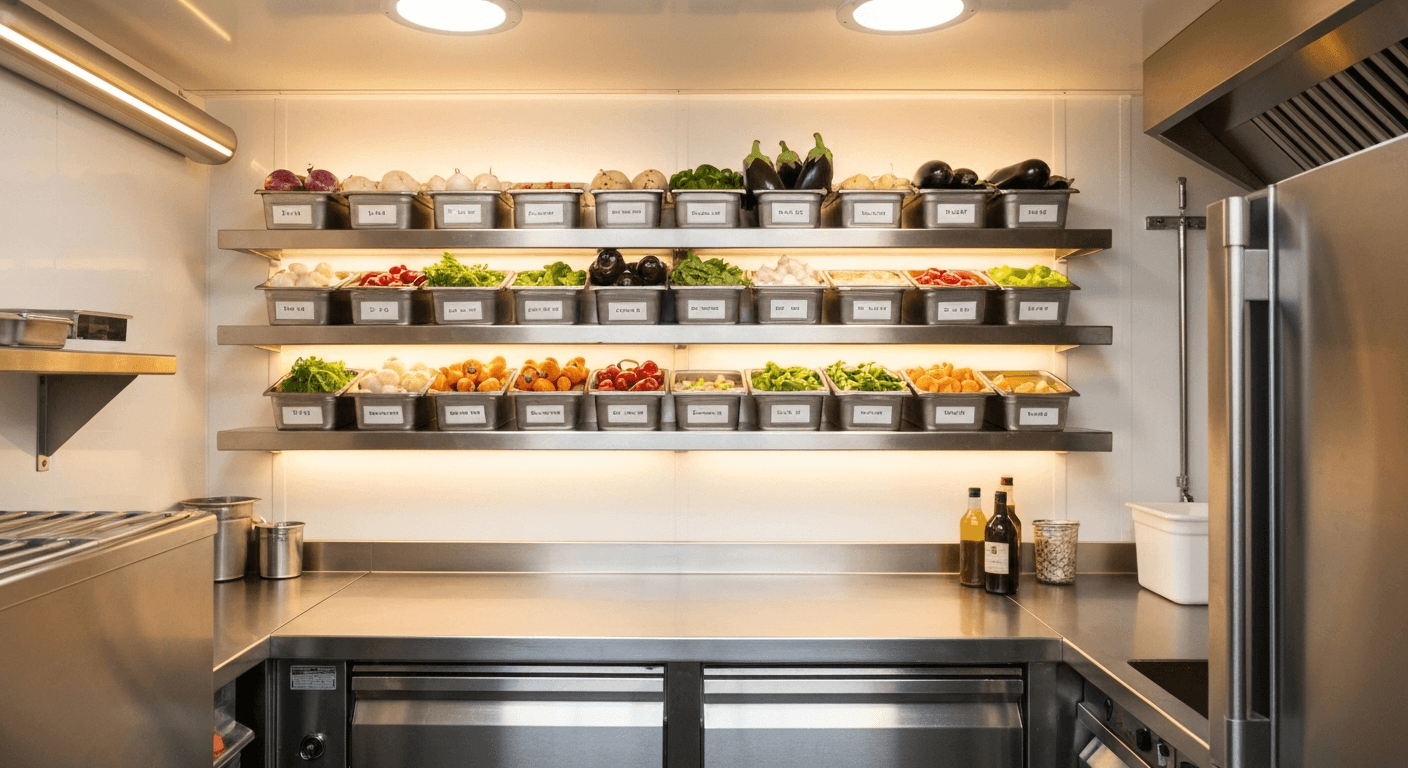
Physical arrangement: when you receive a new delivery, place new products at the back and bring older ones to the front. Simple, but transformative.
Systematic labelling: every packaged product receives a label with its receipt date. Use a simple roll of colour-coded stickers (red for D+2, orange for D+5, green for the rest of the week).
Dedicated fridge zones: create a "use first" zone (open products or those close to their use-by date) and a "reserve stock" zone (products still safely within date).
Products to Monitor First
Not all products carry the same risk:
- Critical (D+1 to D+3): raw meats, fish, beaten eggs, opened creams, homemade sauces
- Medium term (D+3 to D+7): pre-cut vegetables, opened cheeses, cooked preparations
- Long shelf life: bottled condiments, spices, dry goods
Adapting Your Orders to Optimise Rotation
The best way to avoid losses isn't to better manage expiring products — it's to not buy too much in the first place. Over-ordering is the primary cause of poor stock rotation.
Order Based on Your Schedule, Not Out of Habit
Many food truck operators order the same quantities week after week "out of habit". This is a mistake. Your weekly schedule should dictate your orders:
- Light week (2–3 services): order 60–70% of your base amount
- Standard week (4–5 services): order 100% of your base
- Busy week (festival, event): order 130–150% of your base with advance planning
Calculate Your Actual Consumption Per Service
For each key ingredient, track over 4 weeks:
- Quantity used per service
- Quantity discarded (waste)
- Stockouts encountered
Concrete Techniques to Improve Your Rotation Rate
1. The "Bottom-of-the-Basket" Rule
Before each service, do a quick walkthrough of your stock. Identify products nearing the end of their life. Work them into your daily menu: dish of the day, special suggestion, a more generous serving of a side. Turning an at-risk product into the dish of the day lets you value it rather than bin it.
2. Strategic Freezing
Not everything can be frozen, but some products handle it well: portioned meats, stocks, cooked sauces, bread rolls. If you have the right equipment, freezing is a powerful safety net against end-of-week losses.
Check the food safety regulations applicable to your operation beforehand.
3. Standardised Portions
One of the most invisible causes of waste: non-standardised portions. If your cook eyeballs the meat, portions can vary by 20 to 30% across services. Use calibrated weights and containers. You reduce waste, improve consistency, and make purchasing forecasts easier.
4. The End-of-Week "Zero Waste" Menu
On Fridays or before a closure period, offer a simplified menu that clears the week's remaining stock in a coherent, appetising way. A "market plate" or "moment bowl" can become a favourite with your regulars — and saves on the following week's ordering.
Key Indicators to Track Your Rotation
To improve your rotation, you need to measure it. Here are the three essential metrics:
Waste Rate
Formula: (Discarded materials ÷ Purchased materials) × 100
Target a rate below 5% for fresh products. Above 10%, a review of your practices is overdue.
Rotation Rate Per Product
Formula: Quantity used during the period ÷ Average stock during the period
A high rate means you're selling quickly. A low rate on a fresh product is a warning signal.
Actual vs Theoretical Food Cost
Your theoretical food cost is calculated from your recipe cards and sales. Your actual food cost includes losses. The gap between the two reveals the true cost of your waste. On FoodTracks, this calculation is automated: you see in real time whether your actual food cost is drifting from your target.
Integrating Stock Rotation into Your Daily Routine
Stock rotation shouldn't be a one-off project — it's a daily discipline that takes 10 to 15 minutes per service once properly embedded:
Before service:
- Visual check of cold storage zones (2 min)
- Identify products to use first (2 min)
- Adjust prep if needed (variable)
- Quick count of leftover stock (3 min)
- Update your consumption log (2 min)
- Decide what to freeze or carry over to the next day (2 min)
- Full inventory (15–20 min)
- Calculate week's losses
- Adjust order quantities for the following week
How FoodTracks Simplifies Rotation Management
FoodTracks was designed to solve precisely these daily challenges. By connecting your SumUp sales data and purchases, the platform allows you to:
- Visualise your actual consumption by ingredient and by service
- Receive automatic alerts when a product is approaching its use-by date
- Compare theoretical and actual food costs to quantify your losses
- Generate order forecasts adapted to your weekly schedule
Conclusion
Optimising stock rotation in your food truck is not about sophisticated technology or complex processes. It's fundamentally about daily discipline, physical organisation, and data tracking.
Start with the basics: FIFO method, systematic labelling, weekly inventory. Then gradually add the metrics that will allow you to measure and improve your performance. By reducing your losses by just 5 percentage points, you can recover several hundred euros in margin every month — without selling a single extra dish.
Further reading: How to Manage Food Truck Inventory Efficiently · Food Truck Unsold Items Management · How to Create a Profitable Food Truck Menu
Frequently Asked Questions
- What is stock rotation in a food truck?
- Stock rotation refers to how frequently your raw materials are used and replenished. Good rotation means using products before they expire, respecting the order of arrival (FIFO method). In a food truck, where space is limited and products are often fresh, rapid and controlled rotation is essential to avoid waste and financial losses.
- How do you apply the FIFO method in a small truck?
- In a limited space, physical organisation is key. Place new products at the back of your fridge or cupboards, and older ones at the front. Use date-labelled containers. If your space is truly tight, create two clearly marked zones: 'use first' and 'reserve stock'. Even without a digital system, this visual organisation is enough to significantly reduce your losses.
- How often should a food truck do an inventory check?
- A full weekly inventory is the minimum recommended for an active food truck. For fresh products with short shelf lives (meat, fish, dairy), a visual check before each service is essential. The goal isn't to count for the sake of counting, but to detect anomalies: forgotten products, unexpected quantities, imminent stockouts.
- How do you reduce waste at the end of a service?
- Several levers are effective: adapting your production to predictable demand (based on your historical data), offering a 'daily special' to clear products close to expiry, freezing what can be frozen if your equipment allows, or donating to a local food bank what you cannot keep (with potential tax deductions). The key is to anticipate rather than react at the last minute.
- What is the link between stock rotation and food truck profitability?
- Stock rotation directly impacts your food cost, which typically represents 28 to 38% of your revenue. A 5-point improvement in your waste rate (from 12% to 7%) directly translates into better gross margin. On €10,000 in monthly revenue, that's €500 in additional margin every month — or €6,000 per year without selling a single extra dish.