Why Route Planning Is an Underrated Profitability Lever
Most food truckers choose their locations "by feel" or out of habit. That's understandable — you go where things have worked before. But this approach leaves money on the table. By optimising your weekly route, you can increase revenue by 15 to 30% without adding a single extra service.
The principle is simple: every stop has a cost (fuel, travel time, set-up/tear-down) and a revenue potential. A well-planned route maximises the revenue-to-cost ratio across the whole week.
The 4 Criteria for Evaluating a Location
Before building your itinerary, score each potential location on 4 dimensions:
1. Customer Potential
How many people pass your spot during your slot? A Saturday morning market with 2,000 visitors is not the same as an industrial estate with 300 employees at lunchtime. Use free tools like Google Maps (review ratings, density of nearby restaurants) or ask event organisers directly for their footfall figures.
2. Direct On-Site Competition
Are you the only food truck or one of twenty? The rule of thumb: beyond 3 to 4 food trucks at the same spot, individual revenue drops by 30 to 50%. Unless the event generates enough traffic to absorb everyone.
3. Access Cost
Include in your calculation:
- The pitch fee (market, event, private property): from €0 to €200/day depending on the case
- Fuel: calculate the round-trip cost from your base
- Travel time: value your hour at least at minimum wage to account for the opportunity cost
4. Regularity and Customer Loyalty
A recurring spot (every Monday, every Friday) builds a loyal customer base. Customers who know where to find you order more and recommend you more. Excessive variability hurts loyalty. Aim for 60% fixed weekly locations and 40% event-based or rotating spots.
Building Your Weekly Route in 5 Steps
Step 1 — Inventory Your Current and Potential Locations
List all your locations in a spreadsheet (or in FoodTracks) with, for each:
- Average revenue per service
- Pitch fee
- Distance from your base
- Available day(s)
- Satisfaction rating (parking difficulties, water/electricity access, etc.)
Step 2 — Calculate Net Margin Per Location
For each stop, apply the formula:
Net margin = Revenue - food cost - pitch fee - fuel - prorated fixed costs
Don't rely on gross revenue alone. A festival bringing in €800 with 35% food cost, €100 pitch fee and €50 fuel leaves you €370 — less than a regular market at €500 with 30% food cost, €20 pitch fee and €10 fuel: €310 net... but also less stress and wear on your equipment.
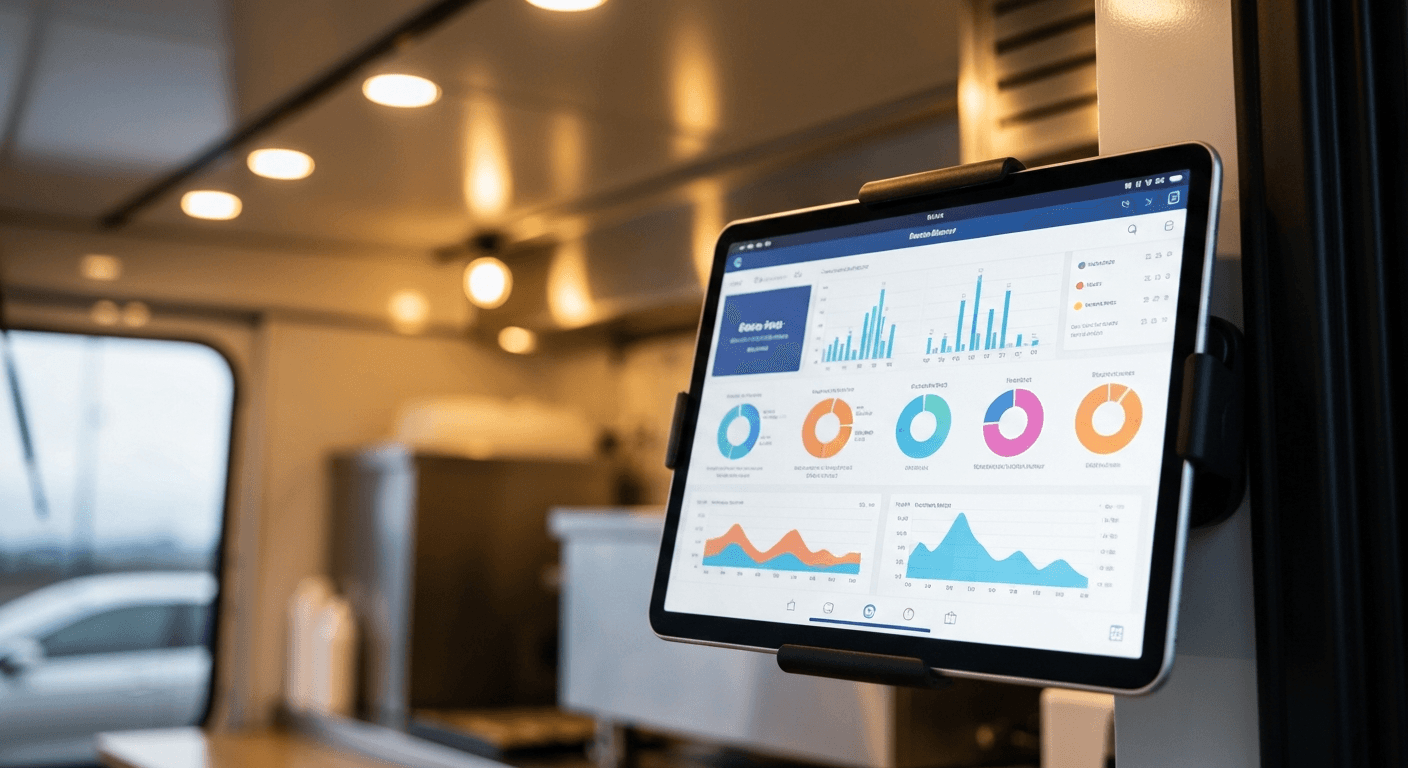
With FoodTracks, you can tag each SumUp sale by location and automatically compare the profitability of each stop over time.
Step 3 — Optimise the Geographical Order
Once you have selected your locations, plan your itinerary to minimise empty kilometres. Use Google Maps or Waze to optimise the order of stops. Golden rule: group nearby locations on consecutive days rather than going back and forth to the same area twice in a week.
Example: if you have 3 locations in the same city (Monday market, Wednesday industrial zone, Friday night market), negotiate parking on-site or nearby to avoid 3 round trips.
Step 4 — Integrate Logistical Constraints
Your route must account for:
- Restocking days: plan a supplier run at the start or mid-week, on your route if possible
- Vehicle maintenance: reserve half a day every two weeks for maintenance (cleaning, equipment checks, servicing)
- Rest days: an exhausted food trucker makes costly mistakes. Plan at least one full day off per week
Step 5 — Test, Measure, Adjust
An optimal route is not built in a week. Schedule a monthly location review:
- Remove stops where net margin is below your minimum threshold
- Replace them with new spots to test (1 new one per week, no more)
- Strengthen your top-performing locations: negotiate more days, offer yourself for special events
Tools for Planning Your Route
Google My Business + Google Maps
Free and essential. Use My Business to appear in local searches at each location. Use Maps to visualise your routes and identify new potential spots (retail zones, business parks, markets).
Route Planning Applications
- RouteXL (free up to 20 stops): optimises the visit order to minimise mileage
- Circuit (paid, ~$30/month): more complete, with real-time tracking and reports
- Google Maps: sufficient for simple routes of 3 to 6 stops per week
FoodTracks for Financial Management
Geographical optimisation alone is not enough: you also need to track real profitability by location. FoodTracks lets you:
- Tag each service by location
- Automatically compare revenue, food cost and net margin for each stop
- Receive alerts when a location underperforms across 3 consecutive services
- Track trends week by week to detect patterns (seasonality, new competition)
The Most Common Planning Mistakes
Multiplying Locations Without Analysing Profitability
Having 15 spots in your notebook is only useful if you know which ones are genuinely profitable. A food trucker doing 6 services per week with 4 well-chosen locations often earns more than one doing 8 services across 10 scattered spots.
Ignoring Travel Time as a Cost
Time between two locations is not "free". It is time when you are not selling, wearing out your vehicle and exhausting yourself. Every hour of travel has a real opportunity cost: what you could have done (resting, prep, prospecting) if you had chosen a closer location.
Changing Locations Too Often
Instability hurts loyalty. If your regular customers don't know where to find you this week, they go elsewhere. Protect your regular slots as commercial assets.
Ignoring Weather in Planning
Weather directly influences your revenue depending on the location. An outdoor market in the rain can cut your revenue in half. Integrate weather forecasts into your weekly planning: keep covered or indoor locations for rainy days, and push festive outdoor spots on fine days. Our article Adapting Your Food Truck Menu to the Weather gives you practical ideas.
Example of an Optimised Typical Route (Solo Food Truck, 5 Days/Week)
| Day | Location | Type | Avg Revenue | Pitch Fee | Fuel | Est. Net Margin | |-----|----------|------|-------------|-----------|------|-----------------| | Monday | Local market | Fixed | €380 | €25 | €8 | ~€220 | | Tuesday | Industrial zone A | Fixed | €450 | €0 | €5 | ~€295 | | Wednesday | Industrial zone B (restocking on route) | Fixed | €420 | €0 | €12 | ~€265 | | Thursday | Festival / event | Variable | €700 | €80 | €40 | ~€360 | | Friday | Night market | Fixed | €500 | €35 | €8 | ~€290 | | Total | | | €2,450 | €140 | €73 | ~€1,430 |
This table illustrates the importance of not judging a location on gross revenue alone: Thursday's festival brings in the most in gross terms, but its net margin is not the highest once costs are deducted.
Conclusion
Planning your food truck route is not a secondary administrative task — it is a strategic management decision that directly determines your profitability. The best food truckers are not necessarily those who work the most, but those who work in the right places.
Start by measuring the true profitability of each location (with FoodTracks or a spreadsheet), then build your route week by week by prioritising high-performing spots, minimising unnecessary kilometres and protecting your regular locations as loyalty assets.
Also read: Choosing a Profitable Food Truck Location · Food Truck Weekly Planning · Optimising Stock Rotation
Frequently Asked Questions
- How many different locations should a food truck have in its weekly route?
- For a solo food trucker doing 5 services per week, 4 to 6 distinct locations is ideal: enough to diversify risk (market cancellation, bad weather) without spreading energy too thin. Beyond 8 different locations per week, travel time and logistical effort start to erode profitability.
- How do you calculate the break-even point of a location to decide whether to keep or drop it?
- Calculate your daily fixed cost (monthly fixed charges ÷ number of working days) then add the variable cost of the location (pitch fee + fuel). The minimum revenue to cover these costs is your location break-even point. If a stop fails to reach this threshold across 3 consecutive services, consider replacing it.
- Do you need specific software to plan your food truck route?
- Not necessarily. A Google Sheets spreadsheet combined with Google Maps is enough to start. For route optimisation with more than 5 stops, RouteXL (free up to 20 stops) is very effective. For financial management by location — the most important part — FoodTracks centralises your SumUp sales by location and automatically calculates the profitability of each stop.
- How do you negotiate new parking spots for your food truck?
- For municipal markets, contact the town hall or chamber of commerce. For business parks, approach park managers or works councils directly — offer a free 2 to 3-week trial. For private locations (shopping centres, car parks), negotiate a fixed pitch fee or a percentage of revenue (5 to 10%). Always bring your average revenue data and references to reassure them.