Why Weekly Planning Is the Backbone of a Profitable Food Truck
Most beginner food truck operators manage their week day by day. Monday morning: "Where should I go today?" Wednesday evening: "I over-ordered tomatoes." Friday: "I missed an event that would have brought in €1,500 because I didn't book the spot in advance."
This reactive approach is costly. A food truck operator who plans their week ahead generates on average 20 to 35% more revenue than a colleague of equal quality who improvises — simply by being in the right place, with the right stock, at the right times.
In this article, we will build together a typical weekly schedule for a solo or two-person food truck, integrating locations, supply management, kitchen prep, and administrative tasks.
What You Will Learn
- The logic of the 5 weekly blocks
- How to choose and sequence your weekly locations
- Organising supplier orders around your schedule
- Kitchen prep: when and what to prepare
- Essential admin time slots (accounting, social media, maintenance)
- A complete 7-day schedule example
The 5 Blocks of a Food Truck Schedule
An effective food truck schedule rests on 5 types of blocks that need to be distributed intelligently across the week:
- Services — customer-facing trading sessions (lunch, dinner, events)
- Supplies — supplier orders and receiving deliveries
- Kitchen prep — mise en place, pre-cooking, marinating, sauce-making
- Admin — accounting, invoices, social media, vehicle maintenance
- Recovery — mandatory rest to sustain performance over time
Block 1: Planning Your Week's Services
How Many Services Per Week?
A solo food truck operator can reasonably handle 4 to 6 services per week while maintaining quality and health. Beyond that, burnout and accident risk increase significantly.
| Profile | Recommended services/week | |---------|--------------------------| | Solo beginner | 4 services | | Established solo | 5 services | | Solo + occasional help | 5-6 services | | Permanent duo | 6-8 services |
The Rule of 3 Location Types
For a balanced schedule, combine these each week:
1. Fixed recurring locations (40-50% of revenue) These are your "cash cow" spots: an industrial estate at lunchtime Monday to Thursday, a weekly market, a private residential agreement. These spots generate predictable income with minimal prospecting.
2. Event locations (30-40% of revenue) Festivals, special markets, corporate events, car boot sales. These require advance planning (booking 2 to 8 weeks ahead) but deliver sales volumes 3 to 5 times higher than a regular service.
3. Development locations (10-20% of revenue) New spots to test, emerging partnerships, new neighbourhoods to explore. This is your investment in future growth.
Sequencing the Week Intelligently
Do not schedule all your services at the start of the week. Here is an optimal sequence:
- Monday: recurring service (getting the week going, checking actual stock)
- Tuesday: recurring or event service
- Wednesday: service + half-day of admin
- Thursday: recurring or development service
- Friday: strong service (end of week = generally better volume)
- Saturday: event service if available, otherwise rest
- Sunday: rest (except exceptional events)
Booking Locations in Advance
The best locations get booked up. To avoid missing a festival or a strategic spot:
- Markets and halls: contact town halls 1 to 3 months ahead
- Private events: respond to calls for proposals as soon as they are published
- Industrial estates: visit and prospect in person, ideally outside service times
- Dedicated apps: local street food directories, or simply Google Maps to identify footfall
Block 2: Synchronising Supplies With Your Schedule
This is where most food truck operators lose the most money. Ordering without a schedule = overstocked perishables = waste. Ordering too tight = stockouts mid-service = lost sales and disappointed customers.
The Cascade Ordering Principle
Your service schedule determines your raw material needs. The logic is simple:
Tuesday service → Order Monday morning at the latest Thursday service → Order Wednesday morning Friday and Saturday services → Order Thursday morning
With next-day delivery from most wholesalers, this approach guarantees you always have fresh produce without stockouts.
Creating Standard Order Sheets Per Service
For each typical location in your schedule, create a standard order sheet:
- Industrial estate service, 80 covers: ingredient list for 80 portions per dish
- Market service, 120 covers: adjusted list
- Festival event, 200 covers: scaled-up list
Consolidating Supplier Orders
Do not order every day. Ideally:
- 1 to 2 main orders per week (meat/vegetable wholesaler)
- 1 weekly order for dry goods and consumables
- Supplier deliveries at the start of the week (Monday/Tuesday) for full visibility
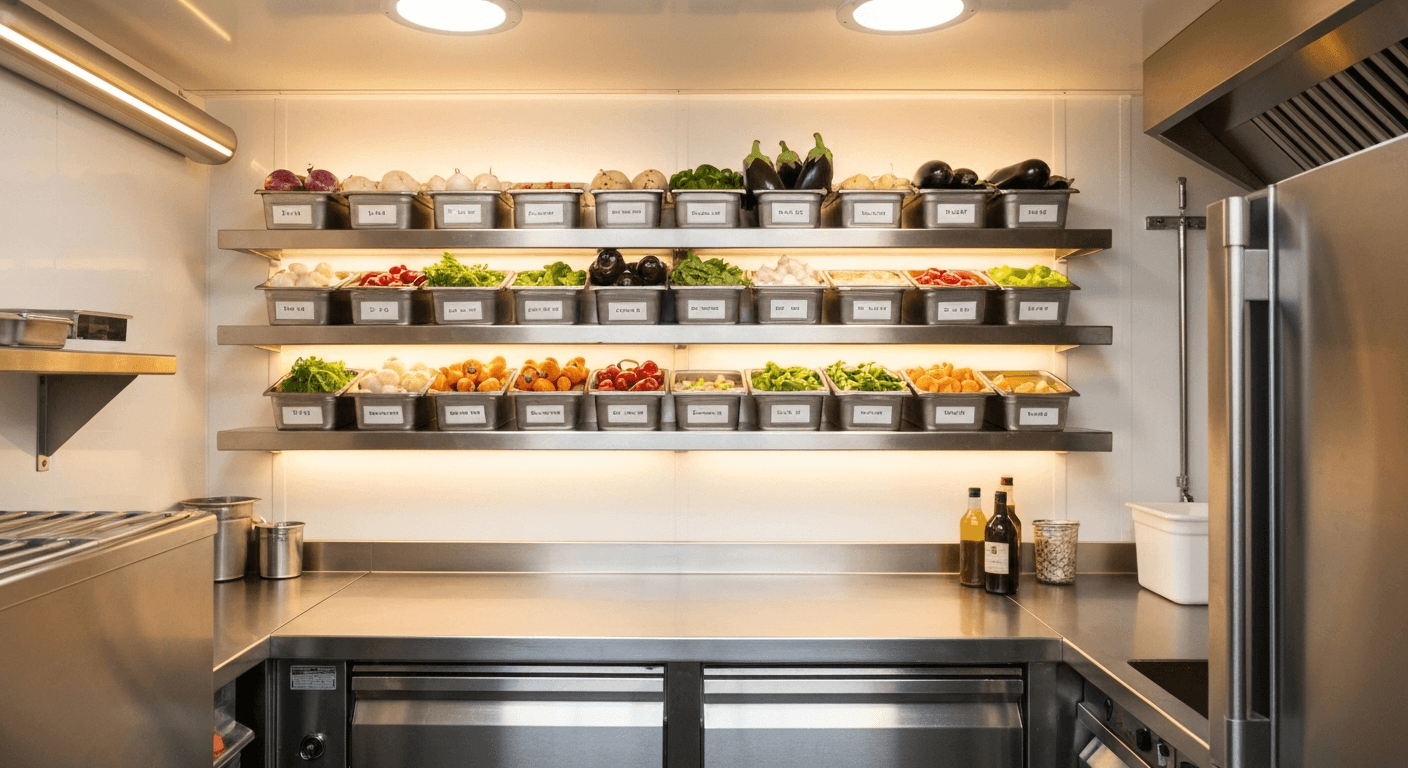
Block 3: Organising Kitchen Prep
Mise en place is often the neglected part of scheduling. Yet good preparation is what makes the difference between a smooth 80-covers-per-hour service and a chaotic 30-covers-per-hour service.
When to Prepare?
The golden rule: never prepare on the morning of a service (except last-minute elements). Stress, time pressure and fatigue cause mistakes.
Here is a typical organisation:
The evening before (1h30 – 2h)
- Defrost meat if needed
- Marinate the meat
- Make house sauces
- Chop vegetables and store in containers
- Check and load the vehicle
- Pre-heat equipment
- Final assembly of preparations
- Set up the counter and display prices
- Test payment equipment (card reader, till)
Batch Prep at the Start of the Week
Some preparations are done once at the start of the week for multiple services:
- House sauces: keep for 5-7 days in the fridge
- Marinades: can be prepared for 3-4 days ahead
- Stable vegetable cuts (onions, peppers): 2-3 days
- Breads: order from your baker in one go for the whole week
Block 4: Essential Admin Time Slots
Many food truck operators neglect admin until it becomes an emergency. The result: late VAT returns, unrecorded invoices, abandoned social media, under-maintained vehicles.
Schedule 2 Admin Slots Per Week
Slot 1 — Financial admin (1h, mid-week)
- Enter the week's supplier invoices
- Reconcile sales (till vs orders)
- Update your dashboard (revenue, food cost, margin)
- Prepare supplier payments
- Thorough vehicle cleaning and maintenance
- Equipment checks (descaling, gas bottle check)
- Social media management (schedule next week's posts)
- Location prospecting and contact with future events
Regular Maintenance That Prevents Breakdowns
A vehicle breakdown mid-service means a full day's revenue lost plus emergency repair costs. A 30-minute weekly maintenance check prevents 80% of breakdowns:
- Check oil level and other fluids
- Check tyre pressure
- Test cooking equipment (burners, fryer)
- Clean filters and extractor hoods
Block 5: Protecting Your Rest Periods
Rest is not wasted time — it is productive time for what comes next. An exhausted food truck operator makes more mistakes, is less welcoming to customers, and makes worse decisions.
The Mandatory Day Off Rule
Give yourself at least 1 day with zero food-truck-related activity each week. This day must be treated like a service — entered in the diary, non-negotiable except in absolute emergencies.
Avoiding the "Just One More Service" Trap
The temptation to add an unplanned service when an opportunity arises is strong. But:
- Every unplanned service disrupts your supply chain
- It reduces your preparation time
- It eats into admin or rest
A Complete Weekly Schedule Example
Here is a typical schedule for an established solo food truck operator:
| Day | Morning | Afternoon / Evening | |-----|---------|---------------------| | Monday | Receive deliveries + stock away | Lunch service — industrial estate (11am–2pm) | | Tuesday | Supplier orders | Kitchen prep (2h) + Financial admin slot (1h) | | Wednesday | Lunch service — market (10am–2pm) | Rest | | Thursday | Kitchen prep (1h30) | Lunch service — industrial estate (11am–2pm) | | Friday | Kitchen prep (1h) | Lunch service + evening event (11am–2pm / 6pm–10pm) | | Saturday | Special market service (9am–3pm) | Operational admin + vehicle maintenance | | Sunday | FULL REST | FULL REST |
This schedule covers 5 services, 2 admin slots, 2 prep slots, and 1 full rest day. That amounts to roughly 45–50 hours of effective work — a sustainable pace over the long term.
Adapting by Season
In peak season (spring-summer), you can push to 6 services by adding Sunday morning at a market. In low season (November-January), drop to 4 services and use the freed-up time for event prospecting and menu updates.
Digitising Your Schedule for Greater Efficiency
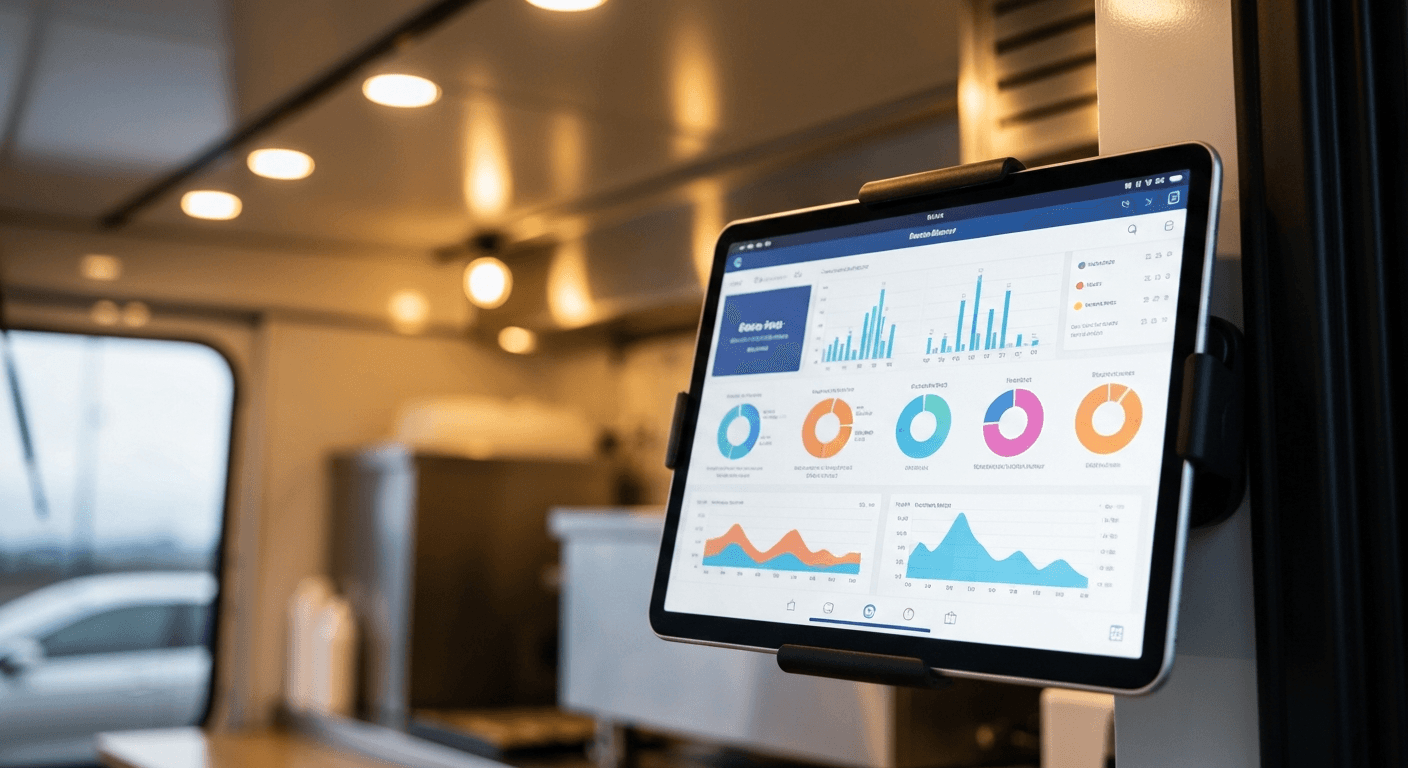
A paper schedule or a simple Google Calendar works, but shows its limits quickly. Digital tools allow you to:
- Sync schedule and stock: automatically trigger orders based on planned services
- Analyse performance by location: which spot earns the most? At what time does your sales peak occur?
- Receive alerts: stock below threshold, unfavourable weather forecasts, upcoming permit renewals
- Track weekly targets: revenue target vs actual, day by day
Try FoodTracks for free and turn your weekly schedule into a genuine profitability engine.
Conclusion
A weekly schedule is not a bureaucratic constraint — it is the tool that transforms an artisanal food truck into a profitable, stress-free business. By balancing services, supplies, prep, admin, and rest, you move from survival mode to growth mode.
The fundamental rule: plan your week every Sunday evening in 20 minutes. Confirm your booked locations, place your orders, and identify your prep slots. Those 20 minutes will save you 10 times as much during the week.
A well-run food truck is not necessarily the one that works the hardest — it is the one that works the most intelligently.
Frequently Asked Questions
- How many services per week for a solo food truck?
- A solo food truck operator can reasonably handle 4 to 6 services per week. Below 4, it is hard to reach profitability unless the events are very lucrative. Above 6, burnout risk increases sharply and service quality degrades. The sweet spot for an established solo operator is 5 services per week, with one guaranteed full rest day.
- How should a food truck organise supplier orders?
- Best practice is to consolidate orders into 1-2 order runs per week, based on your service schedule. Order the morning before your services to receive next day. Create standard order sheets per location type (80, 120, 200 covers) and adjust them based on actual sales. This approach reduces waste, optimises delivery costs, and simplifies accounting.
- When should a food truck do its mise en place?
- Never do mise en place on the morning of a service: time pressure and stress lead to mistakes. The golden rule is to prep the evening before (1h30-2h): marinades, sauces, vegetable cutting, loading the vehicle. On the morning of service (45 min), all that remains is pre-heating, final assembly, and checking payment equipment.
- How can you avoid burnout as a food truck operator?
- Burnout in food trucks rarely comes from a single busy period but from an unsustainable pace sustained over months. Essential safeguards: enforce a full day off every week (non-negotiable), do not exceed 6 services per week when working solo, schedule rest periods like services, and only accept unplanned opportunities if you have both the stock AND the energy for them.
- What tool should you use to plan your food truck week?
- A simple Google Calendar can be enough to start. But to connect your schedule to your stock, sales, and financial targets, a specialist tool like FoodTracks is far more powerful: it integrates your SumUp sales history, alerts you to low stock before each planned service, and lets you compare performance across your different locations to optimise your schedule week after week.