Why Variable Costs Are Crucial for Food Trucks
In the food truck business, profitability often comes down to a few percentage points. And those points are determined by your variable costs. Unlike fixed costs — commissary rent, insurance, truck lease — variable costs move in line with your activity. The more you sell, the higher they climb. But more importantly: the better you control them, the wider your margin grows.
Many food truck operators know their revenue and end-of-month profit, but few can tell you exactly how much each dish sold, each kilometre driven, or each takeaway container actually costs them. Yet it is precisely at that level of detail where profitability gains hide.
In this article, we will walk through every variable cost in a food truck operation, show you how to calculate them, and give you 7 concrete levers to reduce them — without sacrificing quality.
The Main Variable Costs in a Food Truck
1. Raw Materials (Food Cost)
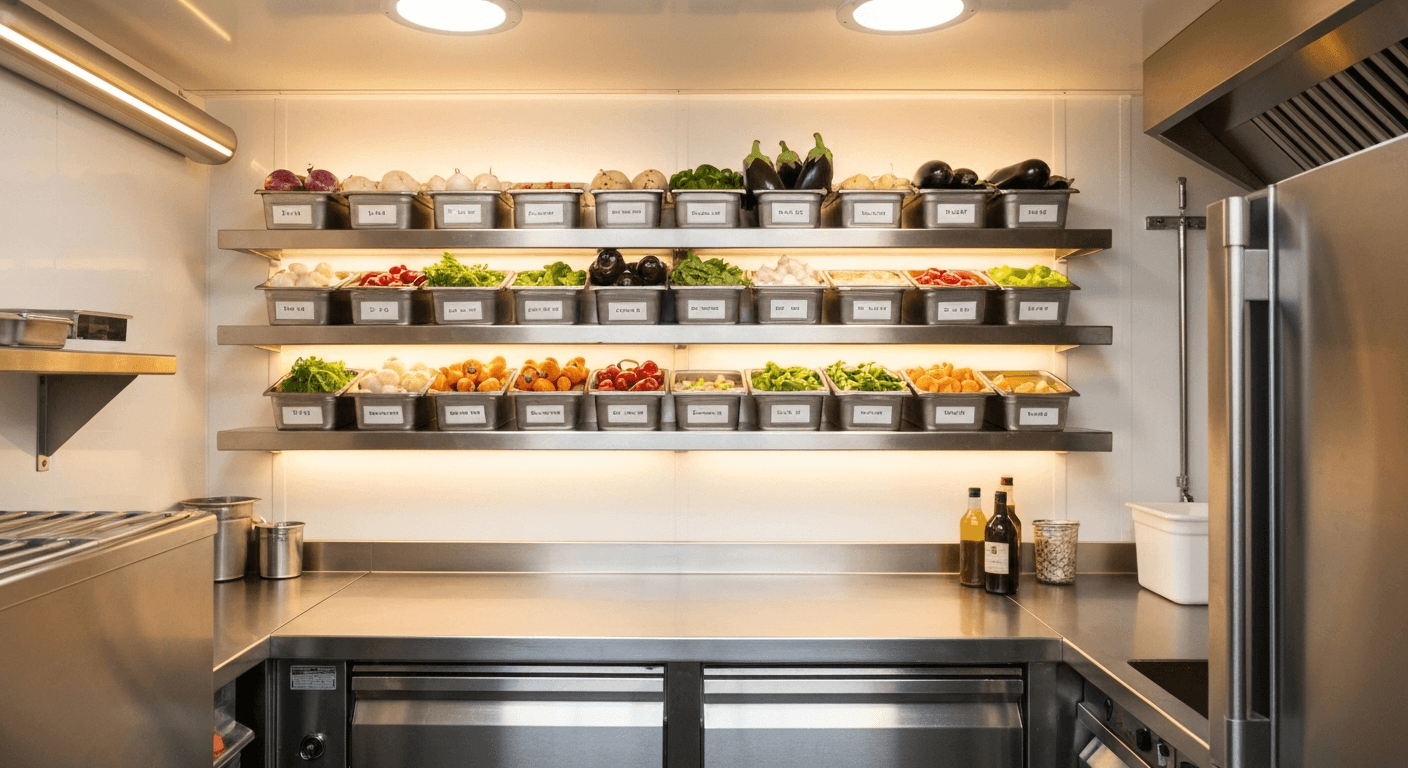
This is the biggest line item, typically 25 to 40% of the selling price depending on your cuisine. Food cost covers every ingredient that goes into your recipes.
Real-world examples:
- A gourmet burger sold at €10 with a food cost of €3.20 → 32% ratio
- A poké bowl sold at €13 with a food cost of €4.50 → 34.6% ratio
- Hand-cut fries sold at €4 with a food cost of €0.80 → 20% ratio
2. Packaging and Consumables
Containers, napkins, kraft bags, disposable cutlery, cups… These costs seem trivial per unit but add up fast. Budget €0.30–0.80 per order on average.
For a food truck doing 80 orders per service and 4 services per week, that works out to:
- 80 × €0.50 × 4 = €160 per week, or €640 per month
3. Fuel and Travel
Fuel is a direct variable cost: the more you drive, the more you spend. Distinguish between:
- Driving fuel to reach your pitch (truck diesel)
- Gas or electricity for cooking during service
- Toll charges where applicable
4. Casual Labour
If you hire extra hands for busy services (festivals, weekend markets), their pay is a variable cost. This includes:
- Gross wages
- Employer payroll taxes
- Any benefits in kind (staff meals)
5. Sales Commissions
If you use delivery platforms (Uber Eats, Deliveroo) or a payment terminal, commissions are variable costs:
- Delivery platforms: 15–30% commission
- Payment terminal (SumUp): 1.75% per transaction
- Market commissions: some pitches take a percentage of revenue
How to Calculate Your Variable Cost Ratio
The Basic Formula
The variable cost ratio is:
Variable cost ratio = (Total variable costs ÷ Revenue) × 100
Full Worked Example
Take a food truck generating €4,000 per week:
| Line item | Amount | % of revenue | |-----------|--------|--------------| | Raw materials | €1,320 | 33% | | Packaging | €160 | 4% | | Fuel | €140 | 3.5% | | Casual labour | €280 | 7% | | POS commissions | €70 | 1.75% | | Total variable costs | €1,970 | 49.25% |
In this example the food truck retains a contribution margin of 50.75% — €2,030 per week to cover fixed costs and generate profit.
The Variable Break-Even Point
For each service, calculate your contribution margin:
Contribution margin = Service revenue – Service variable costs
If this margin is less than the allocated share of fixed costs for that service, it is unprofitable. This is a key metric for deciding whether to keep or drop a pitch. Read more in our article on food truck cash flow management.
7 Levers to Reduce Your Variable Costs
1. Optimise Your Recipe Cards
Every gram matters. By trimming 10% off the weight of certain expensive ingredients (without affecting perceived quality), you can save 2–3 percentage points on food cost.
Action step: weigh every ingredient systematically for one week and compare with your theoretical recipe card. The gaps are often eye-opening.
2. Negotiate With Suppliers
Never rely on a single supplier. Get at least 3 quotes for your 10 most-used products. Price differences can reach 15–25% between suppliers.
Some negotiation levers:
- Order in larger quantities (but watch waste — see our article on stock rotation)
- Commit to a monthly volume
- Pay on delivery instead of net-30
- Buy direct from local producers
3. Reduce Food Waste
Waste is money in the bin. Every euro of wasted raw material directly increases your variable cost ratio. Put in place:
- Daily waste tracking by product
- Standardised portions
- A smaller menu to limit stock variety
- Using leftovers in daily specials
4. Optimise Routes and Pitches
Every unnecessary kilometre costs roughly €0.50–0.80 (fuel + wear). Rationalise your travel:
- Cluster services by geographical area
- Evaluate the real profitability of each pitch (revenue – variable travel costs)
- Drop pitches whose contribution margin does not cover allocated fixed costs
5. Choose the Right Packaging
Review your packaging and look for more cost-effective alternatives without compromising brand image:
- Buy in bulk (pallets) rather than by the case
- Try compostable packaging in high volume (often cheaper above 5,000 units)
- Reduce the number of different formats to benefit from volume effects
6. Control Casual Labour Costs
For every service with extra staff, calculate the break-even point:
- Extra's cost for the service (e.g. €80)
- Additional margin generated thanks to the extra (more customers served, higher sales)
- If additional margin < extra's cost → the service is more profitable solo
7. Track Your KPIs Every Week
The key to controlling variable costs is consistent tracking. Every week, review:
- Your actual vs. theoretical food cost ratio
- Your packaging cost per order
- Your fuel spend per service
- Your overall variable cost / revenue ratio
Using FoodTracks to Monitor Costs in Real Time
FoodTracks was built to give food truck operators complete visibility over their variable costs without spending hours in spreadsheets.
What FoodTracks Does for You
| Feature | Impact on variable costs | |---------|------------------------| | Supplier invoice scanning | Automatic real food cost per ingredient | | SumUp integration | Real-time sales vs. purchases reconciliation | | Recipe cards | Theoretical vs. actual food cost per recipe | | Drift alerts | Notifications when a ratio exceeds your threshold | | Weekly dashboard | Summary view of all your variable costs |
Results Reported by Our Users
- -18% food cost on average after 3 months
- -30% time spent on administrative tracking
- €200–500 in hidden costs identified per month
Conclusion
Variable costs are the number-one profitability lever for your food truck. Unlike fixed costs, you have direct and immediate control over them. Every percentage point you shave off your variable cost ratio translates straight into additional profit.
Start by measuring (you cannot improve what you do not measure), then optimise item by item using the 7 levers outlined in this article. And to automate the entire process, try FoodTracks for free.
Further reading: Food Truck Cash Flow Management · How to Calculate Food Truck Selling Prices · Food Truck Unsold Items Management
Frequently Asked Questions
- What is the difference between fixed and variable costs in a food truck?
- Fixed costs (insurance, lease, subscriptions) stay the same regardless of sales volume. Variable costs (raw materials, packaging, fuel) move in proportion to your activity: the more you sell, the higher they go.
- What percentage of revenue should variable costs represent?
- In a food truck, variable costs typically range from 50 to 65% of revenue. The goal is to keep them below 60% so you have enough margin left after deducting fixed costs.
- How can I reduce raw material costs in my food truck?
- Negotiate volume discounts with suppliers, compare prices regularly, use seasonal produce, optimise your recipe cards to eliminate unnecessary portions, and track waste with a tool like FoodTracks.
- How do I calculate the food cost of a dish in a food truck?
- Add up the cost of every ingredient in the recipe (based on exact weights), then divide by the tax-inclusive selling price. The result, expressed as a percentage, is your food cost ratio. Aim for 25–35%.
- What tools can I use to track variable costs in a food truck?
- FoodTracks is the best-fit solution: it scans your supplier invoices, connects to your SumUp POS and automatically calculates your variable cost ratios per service, per week and per month.