Why Social Media Has Become Essential for Food Trucks
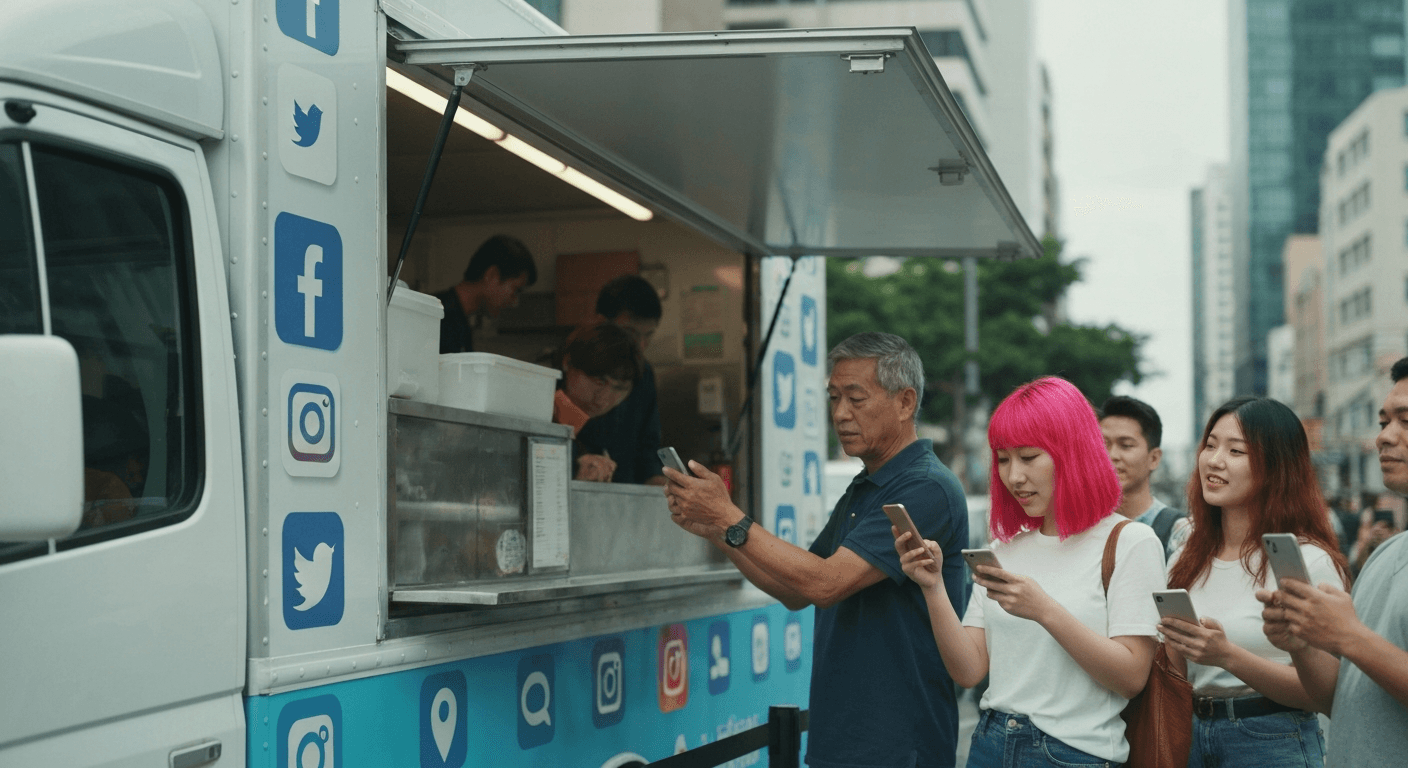
A food truck without a social media presence in 2026 is like a restaurant without a sign: you exist, but nobody knows it. Unlike a fixed address that customers can find on Google Maps, your location changes every day. Social media is your mobile storefront — the only place where your customers can find out where you'll be this morning.
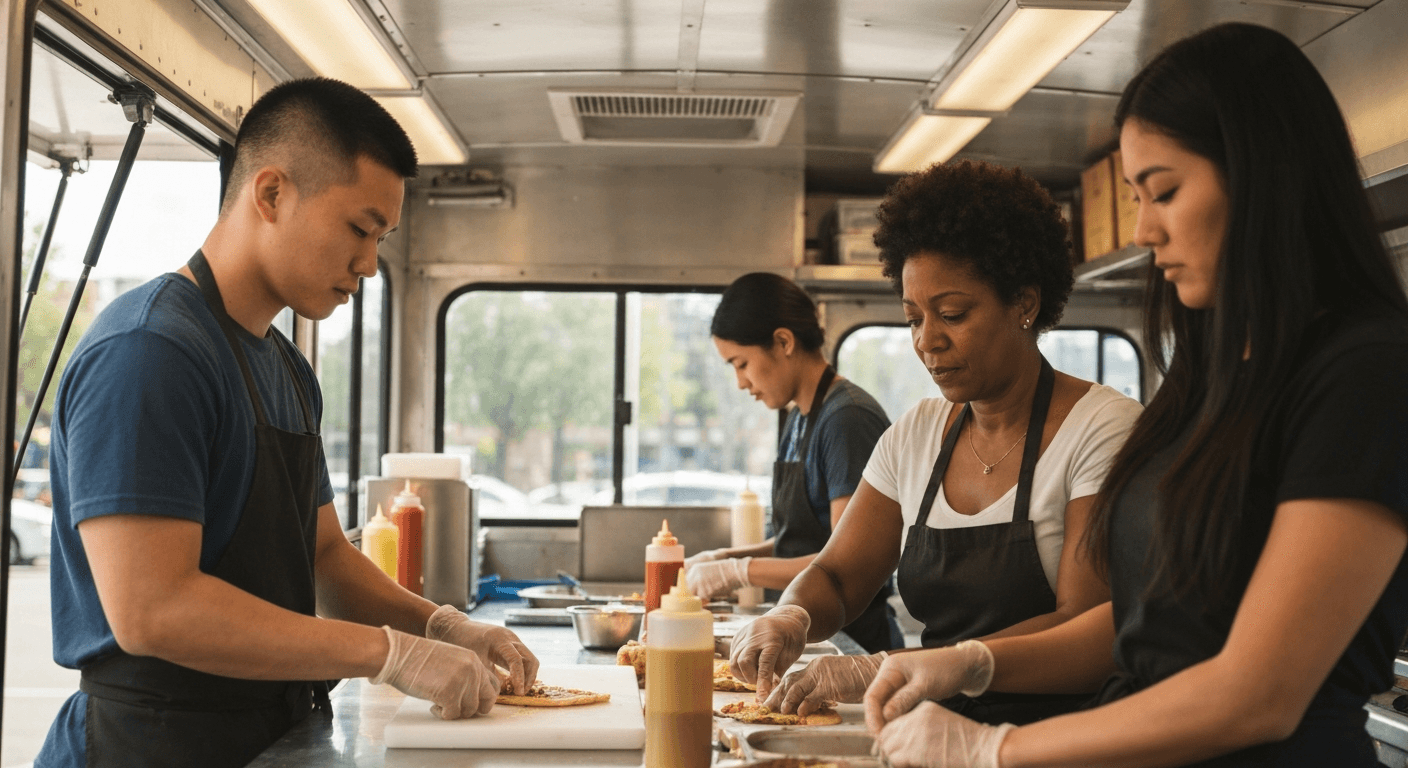
The good news is that food trucks are naturally made for social media. The visual format (enticing dishes, authentic atmosphere, kitchen behind the scenes), the mobility (a new backdrop every day), the local connection (customers who recognise the places) — all of this creates engaging content without particular effort.
What Social Media Can Do for Your Food Truck
- Announce your location to your followers every morning
- Build appetite with appealing photos and videos
- Build loyalty through a community that looks forward to your updates
- Attract new customers in your catchment area
- Manage your reputation by responding to reviews and comments
Instagram: The Essential Network for Food Trucks
Instagram remains the most effective network for food trucks in 2026, for one simple reason: it's a visual platform, and food is one of the most shared topics in the world.
The Perfect Food Truck Account
Start by optimising your profile:
- Profile picture: your logo or a recognisable photo of your truck
- Account name: truck name + city if possible (e.g. @BurgerBusMontpellier)
- Bio: what you do, your city, how to find you, a link to your schedule or website
- Link in bio: a simple page with your weekly schedule (Linktree, public Notion, etc.)
The 3 Types of Content That Work
1. Reels (Short Videos)
Reels are the format that generates the most organic reach on Instagram. For a food truck, ideas are plentiful:
- Preparing a dish in timelapse (30 seconds of transformation)
- Arriving and setting up the truck at a new spot
- The lunchtime rush filmed from inside
- A secret recipe revealed (with the right amount of teasing)
Stories are your real-time communication tool. Every morning, post:
- The day's location with geolocation
- Opening time and estimated closing time
- The dish of the day or new item
3. Photo Posts
For your Instagram feed, focus on appetising photos of your dishes, taken in good natural light. No need to be a photographer: daylight, a simple background and a recent smartphone are enough. Add a description that tells a story (the origin of the recipe, the anecdote of the day, a tip).
Hashtags to Use
Combine niche food truck hashtags with local hashtags:
- Generic food truck: #foodtruck #foodtrucklife #streetfood #foodtrucker
- Local: #foodtrucklondon #streetfoodnyc #foodtrucksydney (adapt to your city)
- Thematic: #burger #tacos #vegan #homemade according to your concept
TikTok: The Platform That Can Change Everything
TikTok has been a major surprise for food trucks in recent years. Several operators have seen their queues triple after a video went viral. What's remarkable is that organic reach on TikTok is still exceptional: a good video can reach tens of thousands of people without spending a penny.
Why TikTok Works for Food Trucks
TikTok's algorithm doesn't favour big accounts — it favours engaging content. A food truck with 200 followers can generate 100,000 views on a video if it's well constructed. And cooking, food and street food videos are among the most watched categories.
TikTok Formats That Work
- The "making of": film the making of a dish from A to Z, with a trending track
- The challenge: "can you guess the secret ingredient in our sauce?"
- Customer reactions: film (with permission) customers trying your food for the first time
- Behind the scenes: pre-opening prep, buying at the supplier market
- Trends: adapt viral sounds and challenges to your food truck world
Linking TikTok to Your Location
Systematically mention your city and location in your TikTok videos. Many people discover food trucks on TikTok and travel specifically to find them. Add your weekly schedule in a pinned comment.
Facebook: The Local Groups Tool
Facebook is less glamorous than Instagram or TikTok, but it remains very useful for food trucks in two specific ways:
Local Groups
Join and actively participate in Facebook groups for your city: "Good Deals [City]", "Going Out [City]", "Food [City]", etc. Post your locations and events there (respecting group rules). These are very active communities where recommendations have a strong local impact.
Facebook Page and Events
Create a Facebook page and use the Event feature for each market, festival or special service. Facebook events are easy to share and reach people who don't follow you yet.
The Week-by-Week Content Strategy
Here's a typical schedule for a consistent presence without spending hours on it:
| Day | Action | Network | |-----|--------|---------| | Monday | Location Story + dish photo | Instagram | | Tuesday | Reel (behind-the-scenes or recipe) | Instagram + TikTok | | Wednesday | Location Story | Instagram | | Thursday | Photo post + question to community | Instagram | | Friday | TikTok video (adapted trend) | TikTok | | Saturday | Market/festival location Story | Instagram + Facebook | | Sunday | Week recap + next week's schedule | Instagram |
This rhythm represents around 45 to 60 minutes of work per week — film during service, edit in the evening or between services.
Mistakes to Avoid
Posting Irregularly
Nothing is more counterproductive than accounts that post 5 times in one week then disappear for 3 weeks. The algorithm penalises irregularity, and your followers forget you.
Never Announcing Your Location
This is the most frequent mistake. Some food truck operators create beautiful dish posts but forget to say where they'll be. Result: the appetite is there, but impossible to find you.
Ignoring Comments and Messages
Responding to comments and DMs within 24 hours boosts your algorithm and creates a personal relationship with your customers. A simple emoji or a short reply is enough.
Neglecting Image Quality
You don't need a DSLR, but blurry, poorly lit or poorly framed photos hurt your image. Film in natural light, stabilise your phone, and avoid overly strong filters.
Measuring the Impact of Your Social Media on Your Business
The real question is: does your social media actually bring in customers?
Metrics to Track on Social Networks
- Reach (how many people see your posts)
- Engagement rate (likes + comments / reach)
- Clicks on the link in bio (for your schedule)
- Story views (and swipe-up rate if you use links)
Correlating with Your Sales Data
With FoodTracks, you can track your revenue per service and location. By cross-referencing this data with your social media statistics (days when you posted a viral Reel vs. the following services), you identify which types of content actually convert into customers.
This type of data analysis — connecting marketing to profitability — transforms a social media strategy into a measurable investment. Check our guide on the food truck KPI dashboard to go further.
Conclusion
Social media is not optional for a food truck in 2026 — it's your primary communication channel. The good news: you don't need a community manager or an advertising budget to start. A smartphone, authenticity and consistency are enough to build a loyal community around your truck.
Start with Instagram (daily Stories for location + 1 Reel per week), add TikTok once you're comfortable with video, and use Facebook for local groups. Then measure the impact on your sales with FoodTracks to refine what truly works.
Try FoodTracks for free to connect your marketing to your sales performance.
Also read: Building customer loyalty for your food truck · Choosing the right food truck location · Food truck weekly planning
Frequently Asked Questions
- Which social network is most effective for a food truck?
- Instagram is the most effective network for a food truck in 2026, particularly through Reels (short videos) and geolocated Stories. TikTok is gaining ground for organic reach, especially with 18-35 year olds. Facebook remains useful for local groups and events. The ideal approach is to start with Instagram, then add TikTok once you are comfortable with video content creation.
- How often should a food truck post on social media?
- The recommended frequency is 3 to 5 publications per week on Instagram, split between Reels (1-2/week), daily Stories (today's location, behind the scenes) and photo posts (1-2/week). On TikTok, aim for 2 to 4 videos per week. Consistency matters more than frequency: 3 quality posts per week beats 7 rushed ones.
- How to find content ideas for a food truck on social media?
- The best-performing food truck content includes: preparation behind the scenes (film your recipes in timelapse), today's location announcement, customer reactions (with permission), menu updates, field anecdotes (challenges, wins), and before/after transformations (ingredient to finished dish). Adapting TikTok trends to your universe organically boosts your reach.
- Do you need an advertising budget to promote a food truck on social media?
- No, a food truck can grow on social media without an ad budget, especially on TikTok and Instagram Reels where organic reach is still strong. A budget of €50 to €100/month boosting location posts on Facebook can be useful for targeting residents in your catchment area. But the priority remains authentic, consistent content, which costs nothing but time.
- How do I measure whether my social media is actually bringing customers to my food truck?
- The simplest way is to directly ask new customers 'How did you hear about us?' and note the answers. You can also create a social-media-exclusive promo code and count uses. With FoodTracks, cross-reference your sales data per service with your engagement peaks to identify whether your best-performing posts correspond to your best services.