Why Your POS Choice Is a Strategic Decision
In a food truck, your till is not just a tool for collecting payments. It is the backbone of your financial management: every recorded transaction is a data point that lets you understand your best hours, your most profitable dishes, and how your revenue evolves service by service.
Yet many food truckers choose their card reader on a single criterion: the price of the hardware. This is a common mistake that can be costly in the long run — in hidden fees, missing data, and manual entry time.
This guide helps you choose the right solution in 2026, taking into account French regulations, real costs, and integration with your management tools.
---
What Your Food Truck POS Must Do (and What Many Overlook)
The basics
A POS system adapted to a food truck must:
- Process payments quickly: in the middle of a service, you cannot afford 30 seconds per order. The interface must be touch-based, intuitive, with shortcuts per dish.
- Accept all payment methods: bank card (contactless, chip), Apple Pay, Google Pay, and cash.
- Work offline: market or festival venues often have unstable connectivity. Your terminal must store transactions locally.
- Print or send receipts: legally required on request in France, and useful for your accounting.
The often-overlooked features
Beyond payment collection, a good food truck POS should also:
- Track sales by item: knowing you sold 47 burgers and 23 salads in a service is the foundation of performance monitoring.
- Export your data: to your accountant, your management app, or your spreadsheet.
- Handle discounts and promo codes: if you run loyalty programmes.
- Be NF 525-certified: mandatory if you are VAT-registered (see the regulation section below).
The Main Solutions in 2026: An Honest Comparison
SumUp — The French food truck standard
SumUp is by far the most widely used solution by food truckers in France. Its strengths:
- Compact and robust hardware: the SumUp Air (€39) and SumUp Solo (€79) fit easily into any workspace.
- Among the lowest transaction fees: 1.69% per transaction (no subscription), or a €25/month subscription to drop to 0.99%.
- Free POS app: SumUp POS Lite is included, with item management and basic statistics.
- Native FoodTracks integration: your SumUp sales sync automatically into FoodTracks for real-time margin tracking.
Square — Powerful but more expensive
Square offers a complete ecosystem (POS, stock, bookings, marketing) but its fees are higher (1.75% to 2.75%) and its hardware is less suited to heavy outdoor use.
Best for: food trucks that also sell online or have multiple points of sale.
Zettle by PayPal — The mid-range option
Zettle (formerly iZettle) offers a terminal at €79 with fees of 1.75% per transaction. Its PayPal integration is an advantage if you already have a PayPal business account.
Best for: food truckers who receive online payments via PayPal.
Dedicated iPad POS (Lightspeed, Tiller, Zelty)
These solutions are designed for restaurants: table management, recipe costing, multi-till setups. They are too heavy and too expensive (€49 to €149/month) for the vast majority of food trucks. Reserve them for operators with several trucks or a fixed venue alongside.
---
French Regulations: What You Need to Know
The anti-VAT-fraud law (2018)
Since 1 January 2018, any VAT-registered professional must use POS software or a payment collection system that meets the requirements of immutability, security, retention and archiving of data.
The software must be NF 525-certified (by an accredited body) or come with an individual publisher attestation compliant with the tax authority's template.
In the event of an audit, the absence of certification can result in a €7,500 fine and a requirement to comply within 60 days.
Good news: SumUp, Square and Zettle all provide compliance attestations for French regulations. Make sure your app version is up to date.
Micro-entrepreneurs not subject to VAT
If you operate under the VAT exemption threshold (turnover < €37,500 for catering activities), you are not subject to the NF 525 certification requirement. You can therefore use any payment collection tool.
---
Connecting Your POS to Your Financial Management
The data silo trap
The problem for food truckers who use only their payment terminal: data stays locked inside the till app. You can see your day's revenue, but not:
- Your real margin per dish (after deducting the cost of ingredients)
- How your food cost evolves week by week
- Your best locations relative to your sourcing costs
FoodTracks + SumUp: the winning combination
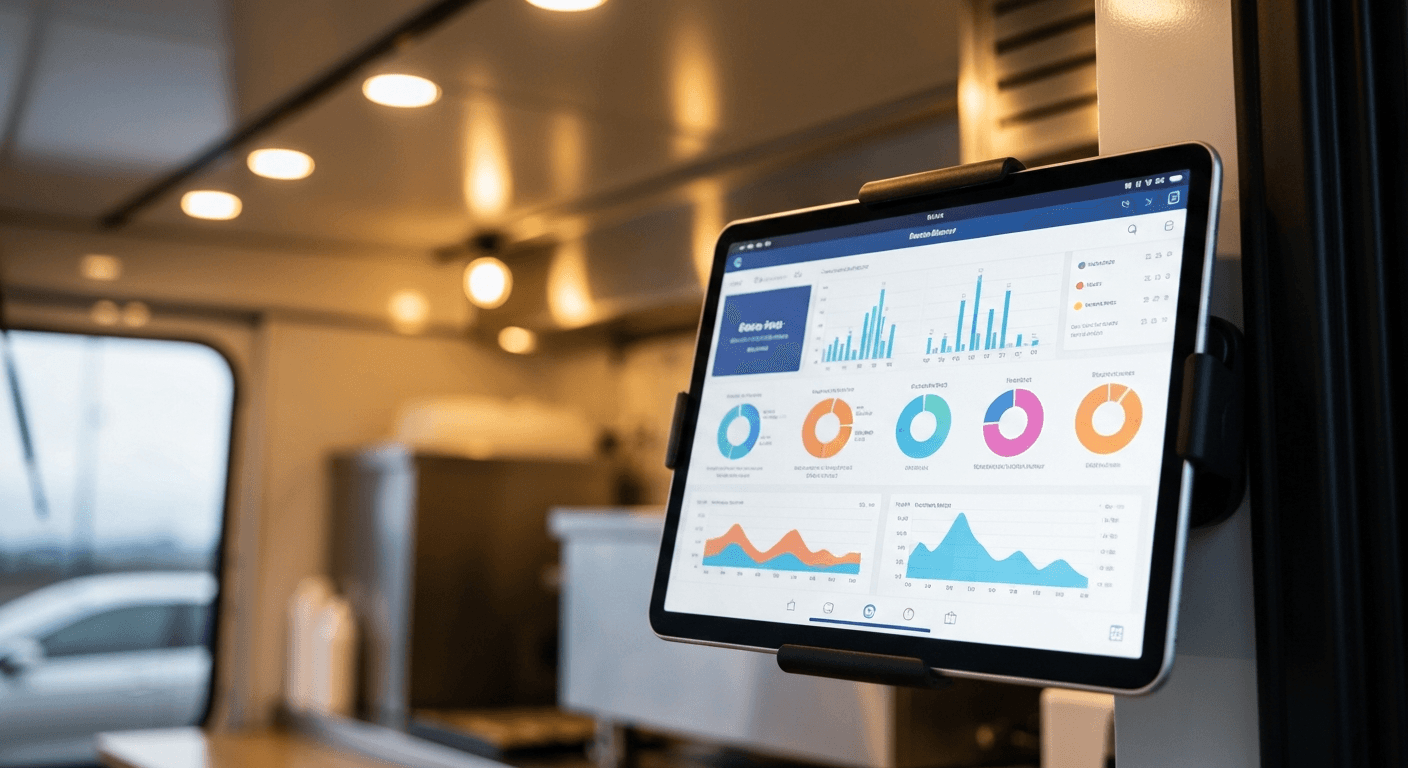
By connecting SumUp to FoodTracks, every sale recorded at the till automatically feeds your management dashboard:
- Sales imported in real time: revenue by service, by dish, by hour
- Margins calculated automatically: FoodTracks cross-references your sales with your supplier invoices (imported by scan or photo)
- Drift alerts: if your food cost exceeds your target threshold, you are notified
- Profit per location: compare the profitability of your different spots
---
Mistakes to Avoid When Choosing Your POS
Mistake 1: Choosing on hardware price alone
The €29 card reader might seem attractive, but if its transaction fees are 2.75% versus SumUp's 1.69%, on €5,000 monthly revenue that means €53 in extra fees per month, or €636 per year.
Mistake 2: Overlooking offline mode
A festival or outdoor market can have poor network coverage. If your terminal does not work without a connection, you lose sales — and your reputation. Always test offline mode before your first service.
Mistake 3: Not retrieving your data
Some food truckers never look at their till statistics. It is an untapped goldmine: your 5 best-selling items, your peak hours, your average basket… This data should inform your menu and planning decisions.
Mistake 4: Ignoring NF 525 certification
If you are VAT-registered, a simple spreadsheet or non-certified till exposes you to a fine. Check your solution's compliance before opening.
---
How to Set Up Your Food Truck POS in 5 Steps
- Assess your transaction volume: fewer than 50 transactions/day → SumUp Air is sufficient. More than 100 → consider the SumUp Solo or a system with a printer.
- Check your VAT status: if you are VAT-registered, ensure your solution is NF 525-certified.
- Configure your item catalogue: enter all your dishes with their prices in the POS app. This gives you per-item statistics from your very first service.
- Connect FoodTracks: link your SumUp account to FoodTracks to sync your sales and start tracking your margins.
- Test offline mode: switch off Wi-Fi and mobile data, run a test transaction, then reconnect to verify synchronisation.
What Does a Food Truck POS System Really Cost?
Here is a concrete example for a food truck turning over €5,000 per month:
| Solution | Hardware | Fees/month (rate) | Subscription | Total/month | |---|---|---|---|---| | SumUp Air (no sub) | €39 (one-off) | €84.50 (1.69%) | €0 | ~€87 | | SumUp Pro (with sub) | €39 (one-off) | €49.50 (0.99%) | €25 | ~€77 | | Square | €49 (one-off) | €87.50 (1.75%) | €0 | ~€91 | | Zettle | €79 (one-off) | €87.50 (1.75%) | €0 | ~€95 |
Conclusion: for a growing food truck, the SumUp Pro subscription pays for itself from €3,500 of monthly revenue. Below that, stay on the no-subscription plan.
---
What FoodTracks Adds to Your POS
A POS system records your revenue. FoodTracks records your margins.
The difference? FoodTracks cross-references your sales (imported from SumUp) with your supplier purchases (scanned from your invoices) to calculate in real time:
- Your food cost per service and per week
- Your most profitable dishes (not just the best-sellers)
- Your real gross margin after ingredients
- Stock drifts (waste, theft, portioning errors)
---
Conclusion: Your POS, the Starting Point for Smart Management
Choosing your food truck POS system means choosing the quality of the data on which you will run your business. A simple, inexpensive terminal may be enough to collect payments — but only a system connected to your management tools lets you understand and improve your profitability.
In 2026, the SumUp + FoodTracks combination stands out as the reference for French food truckers who want to professionalise their management without blowing their budget. Start by connecting your two tools and see your margins in a new light from your very next service.
Frequently Asked Questions
- What POS system should a beginner food trucker choose?
- For a beginner, SumUp or Square are the simplest choices: 10-minute setup, pay-per-transaction fees (no fixed subscription), and lightweight hardware. The SumUp Air costs around €39 and accepts card, contactless, and Apple/Google Pay payments.
- Does French law require food trucks to have a certified till?
- Yes, since 1 January 2018, any VAT-registered professional must use a certified POS software or till system (NF 525 or equivalent). An attestation from the software publisher or certification from an accredited body is required in the event of a tax audit. Micro-entrepreneurs not subject to VAT are exempt.
- Can you take payments without an internet connection in a food truck?
- Yes, most modern terminals (SumUp, Square, Zettle) work in offline mode for card payments: transactions are stored locally and synced as soon as the connection is restored. For cash, no connection is needed of course. Do check the offline transaction amount limits permitted under your contract.
- How do I connect my food truck till to my management software?
- It depends on the solution chosen. FoodTracks connects natively to SumUp via API: your sales sync automatically, service by service, without manual entry. For other tills, a daily CSV export is often sufficient. The ideal is a real-time connection so you can monitor your margins every day.
- What are the real costs of a payment terminal for a food truck?
- There are three cost categories: (1) hardware (terminal or card reader: €39 to €299), (2) transaction fees (from 1.69% with SumUp to 2.75% with some Square plans), and (3) optionally a monthly subscription (€0 to €69/month depending on features). For a food truck turning over €5,000 per month, transaction fees represent roughly €85 to €140 per month.