Why So Many First Food Trucks Close Within 18 Months
The food truck dream is seductive: freedom, passion for cooking, direct customer contact. Yet 40 to 50 % of food trucks close within the first two years. The number one reason isn't lack of culinary talent — it's lack of business preparation.
This guide isn't another article on "how to get a licence". It's an honest breakdown of what you actually need to do — and avoid — to turn your first food truck into a sustainable business.
Step 1: Validate Your Concept BEFORE You Buy
The classic beginner mistake: buy or rent a truck, fit it out, then hope customers show up. Validate first, invest second.
How to Test Without a Truck
- Markets and fairs: rent a food stall for €50–€200 per day. Test your menu, pricing and execution speed.
- Pop-ups at friends' homes or shared spaces: offer your concept informally.
- Weekend catering: take a few orders evenings or weekends before leaving your day job.
The 3 Questions to Answer Before Any Investment
- Does my concept sell in 45 seconds? A food truck needs to be understood at a glance. If you need to explain your menu, it's too complex.
- Does my average ticket cover my costs? Calculate your cost per dish from day one.
- Where are my customers? Identify 5 potential locations even before you have a truck.
Step 2: Budget Realistically
The Real Start-Up Budget
| Item | Low budget | Mid budget | |---|---|---| | Fitted vehicle (second-hand) | €20,000 | €35,000 | | Kitchen equipment | €8,000 | €15,000 | | Admin and permits | €1,500 | €2,500 | | First stock + consumables | €3,000 | €5,000 | | Insurance (year 1) | €3,500 | €5,000 | | Marketing + website | €1,500 | €3,000 | | Start-up cash reserve | €8,000 | €15,000 | | Total | ~€45,000 | ~€80,000 |
The cash reserve is almost always underestimated. In the early months you'll have zero-revenue weeks — bad weather, a failed pitch, a breakdown. Plan for 3 to 4 months of fixed costs sitting in your bank account.
Available Funding
- ACRE (France): partial exemption from social charges in year one
- ARCE: lump-sum payment of 60 % of your unemployment entitlement if you were previously employed
- Prêt d'honneur: interest-free loans of €5,000–€50,000 from Initiative France or Réseau Entreprendre
- BPI France: bank loan guarantee up to 70 %
Step 3: Build a Simple, Profitable Menu
The 7-Item Rule
A profitable food truck has a short menu. 7 to 9 items maximum (excluding drinks), for three reasons:
- Speed of execution: fewer preparations = shorter service time = more customers served
- Inventory control: fewer SKUs = less waste = better margins
- Brand clarity: a strong speciality is remembered; a generalist menu is forgotten
Calculate Your Margins From Day One
Your break-even point is straightforward:
Break-even = Fixed costs ÷ (1 − food cost % / 100)
If your monthly fixed costs are €4,000 and your food cost ratio is 30 %, you need €5,715 in monthly revenue to break even. That's roughly 50–60 covers per day over 20 trading days.
Step 4: Find and Secure Your Locations
Location is your most valuable asset. A great spot can multiply your revenue by 3 to 5 compared to an average one.
Types of Locations
- Food markets: regular, captive audience, good visibility
- Industrial estates / offices: strong lunchtime potential on weekdays, low competition
- Events (festivals, car boot sales): high volumes but unpredictable
- Private subscriptions: companies, campuses — predictable recurring income
Getting Permits
Every spot on public roads requires a stationnement permit issued by the local council. Requirements vary by municipality. Check our guide on food truck parking authorisations to make sure you cover everything.
Test Before You Commit
Never sign an annual pitch contract before testing it at least four times. Track revenue per service, customer profile and direct competition.
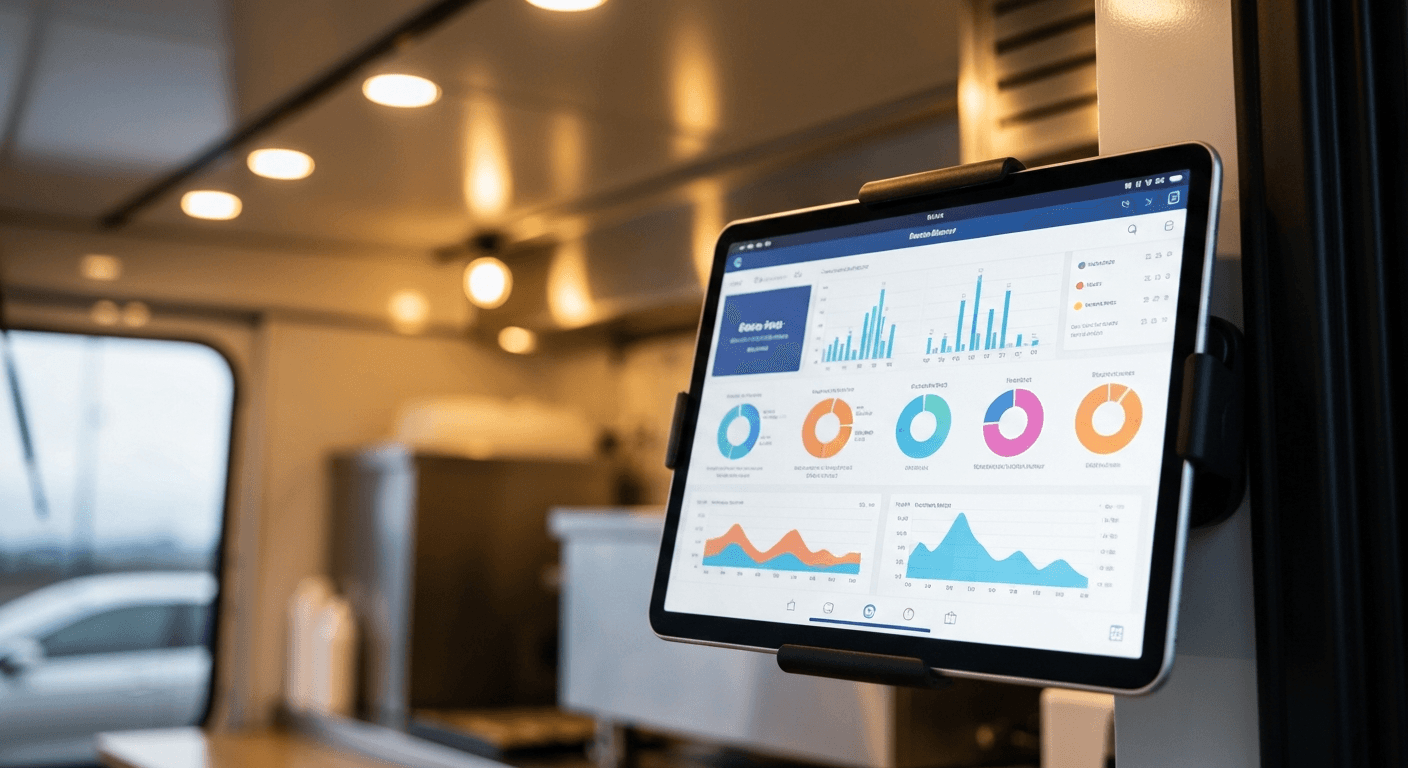
Step 5: Track Your Numbers From Day One
The "I'll Look at the End of the Month" Trap
Many beginner food truckers only look at their figures at month-end — by which point it's too late to change anything. An unprofitable service today costs real money tomorrow.
The 5 Indicators to Monitor Every Week
- Revenue per service and per location
- Average ticket (target: grow it by 5–10 % in six months)
- Food cost ratio (target: below 35 %)
- Number of covers per service
- Food waste (target: less than 5 % of revenue)
The 5 Most Common Beginner Mistakes
1. Underestimating Fixed Costs
Commissary kitchen rent, loan repayments, insurance, accountant fees — these charges run even when you're not trading. List them all before you start.
2. Neglecting Vehicle Maintenance
A deep-fryer failure on a Saturday morning at a festival can cost €3,000–€5,000 in lost revenue in a single day. Budget €1,500–€3,000 per year for maintenance and keep an emergency fund.
3. Pricing Too Low
The beginner syndrome: cut prices to attract customers. It's a fatal spiral. Set your selling prices based on your real margins from the start, and adjust your concept if the market won't support them.
4. Ignoring Social Media in the First Weeks
Your Instagram page and Google Business listing must be active before your first service. Document the build-out, the truck delivery, early tastings. That initial audience will become your first customers.
5. Working Alone With No Help
A full-speed food truck needs at minimum one person cooking and one at the till. Solo, you'll be overwhelmed quickly, service will slow, and customers won't return. Plan for at least one casual worker or partner for busy services.
Key Takeaway
Launching your first food truck is a demanding but achievable adventure — for those who prepare properly. The formula: test before investing, calculate before deciding, measure to improve.
Food truckers who succeed in year one aren't necessarily better cooks — they simply have clear numbers, tested locations and a profitable menu. FoodTracks is built to give you exactly that visibility, from your very first service.
Frequently Asked Questions
- What budget do I need to open my first food truck?
- The realistic budget to open a first food truck is between €40,000 and €90,000, including the fitted vehicle, kitchen equipment, permits, insurance, first stock, and a 3–4 month cash reserve. Underestimating the cash reserve is the most common mistake.
- How long does it take to become profitable with a food truck?
- With proper preparation, a food truck can reach break-even within 6 to 12 months. Operators who validate locations before investing and track their margins in real time reach profitability faster. Without number tracking, many operate blind for 18 to 24 months.
- How many items should a beginner food truck menu have?
- 7 to 9 items maximum (excluding drinks) for a beginner food truck. A short menu speeds up service, reduces waste, and reinforces your specialist image. You can expand later once the operation is running smoothly.
- Do I need a commissary kitchen to start a food truck?
- In France, regulations require all food preparation to take place in a HACCP-compliant facility. If your truck doesn't have a sufficient prep area, you must rent an approved commissary kitchen. Budget €300–€800/month depending on the region and included equipment.
- What are the most common mistakes when launching a food truck?
- The 5 most common mistakes are: underestimating fixed costs and the cash reserve needed, offering too wide a menu, failing to test locations before committing, setting prices too low to attract customers, and neglecting social media before launch. These mistakes combined account for the majority of early closures.