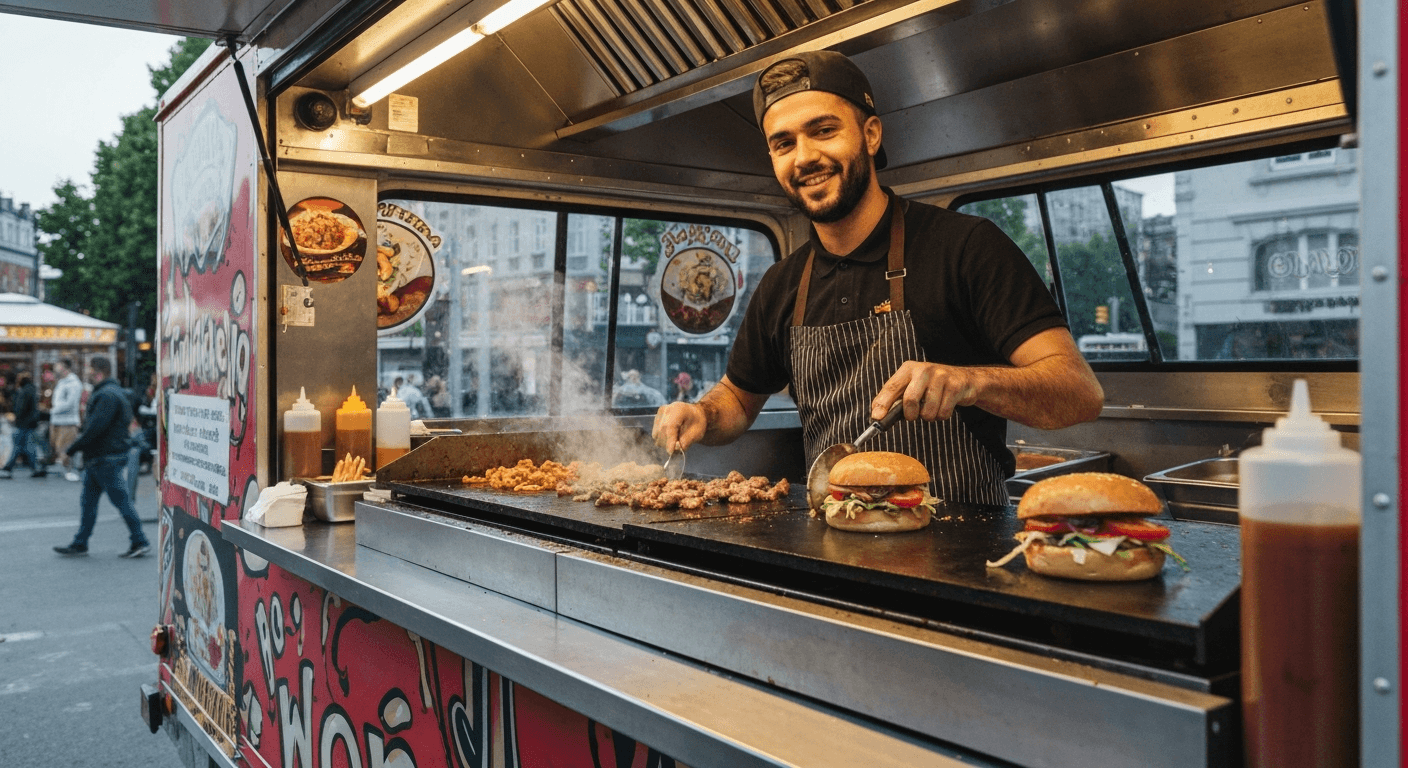
Why Location Is the Most Important Decision for Your Food Truck
If there's one rule to remember in the food truck business, it's this: location drives revenue. You can have the best burger in town, flawless branding, and 5-star Google reviews — if you're parked on an empty street, you won't sell anything.
Industry studies estimate that location accounts for up to 70% of a food truck's commercial success. That's more than product quality, more than pricing, more than marketing. An average food truck in an excellent location will always outperform an excellent food truck in a bad location.
In this article, we'll give you a concrete method to identify, test, and optimize your food truck locations to maximize your revenue year-round.
The 6 Criteria for Evaluating a Food Truck Location
1. Foot Traffic: The Number One Factor
The first success factor is the number of people walking past your truck. But beware: not all foot traffic is equal. A flow of 1,000 people rushing to the subway isn't worth a flow of 200 people strolling through a market.
What matters:
- Volume: how many people pass by per hour during your selling window
- Speed: slow traffic (markets, parks) converts better than fast traffic (train stations, avenues)
- Recurrence: daily traffic (office areas) is worth more than occasional traffic (annual festival)
- Intent: people looking for food (office district at noon) convert 5x better than random passersby
2. Direct and Indirect Competition
A busy location with 5 food trucks and 10 restaurants around it won't necessarily be profitable. Analyze:
- Number of direct competitors (other food trucks, snack bars, fast food)
- Type of cuisine offered: if there are already 3 burger trucks, don't show up with a 4th
- Price levels: if the area is used to very low prices, your margin will be squeezed
- Perceived quality: a high-end market with little competition is ideal
3. Accessibility and Logistics
A location can look perfect on paper but be impractical in reality:
- Vehicle access: your truck weighs 3.5 tons and is 6 meters long — verify you can physically access, maneuver, and park
- Electrical hookup: do you need a power outlet? Does the spot offer one?
- Water supply: depending on your operation, water access may be essential
- Travel time: a spot 1.5 hours from your base reduces profitability (fuel, time, fatigue)
- Customer parking: in rural or suburban areas, nearby parking is a plus
4. Local Regulations
This is the point that trips up most beginner food truckers. You can't park just anywhere. Each type of location has its own rules:
| Location Type | Required Permit | Where to Apply | |---|---|---| | Public road | Temporary Occupancy Authorization (AOT) | City Hall / Prefecture | | Market | Pitch allocation by market manager | City Hall / Market Services | | Private land | Occupancy agreement | Property owner | | Shopping area | Manager's approval | Shopping center management | | Event | Pitch contract | Event organizer |
Key warnings:
- The AOT is usually paid (monthly or annual fee) and revocable
- Some municipalities outright ban street food vending
- Rules change from one city to the next — what's allowed in one town may be banned in the neighboring one
- Fines for unauthorized parking range from €135 to vehicle impoundment
5. Seasonality and Weather
A location can be excellent in summer and disastrous in winter. Consider:
- Seasonal traffic patterns: a beach is packed in July, empty in November
- Weather protection: a sheltered spot (covered hall, arcade) holds up better in rain
- Local habits: some markets only run in summer, others year-round
- Weather impact on sales: on average, rain reduces sales by 30–50%
6. Customer Loyalty Potential
A good location is also a place where you can build a regular customer base. Spots where you return every week at the same time let you build loyalty, as customers develop the habit of coming to see you.
- Office districts are ideal for loyalty: employees eat at the same place every day
- Weekly markets create a regular appointment
- One-off event spots don't build loyalty — they bring volume but not recurrence
The Best Types of Food Truck Locations
Office Districts and Business Parks
Time slot: Monday to Friday, 11:30 AM – 2:00 PM Potential: ★★★★★
This is the king of food truck locations. Office workers want a quick, quality alternative to the cafeteria. The traffic is massive, recurring, and predictable. The average ticket is often high ($14–18).
How to get in: Contact the business park manager or company HR/works council. Some areas offer dedicated food truck pitches.
Weekly Markets
Time slot: 1 to 3 mornings per week Potential: ★★★★☆
Markets offer a natural flow of people who came to buy. Attendance is regular and the customer base is loyal. The downside: hours are early (setup from 6 AM) and spots are often allocated by seniority.
University Campuses
Time slot: Monday to Friday, 11:30 AM – 2:00 PM (excluding holidays) Potential: ★★★★☆
Students are a large, regular, and connected customer base (word-of-mouth on social media). The average ticket is lower ($9–12) but volume makes up for it. Watch out for university holiday closures.
Events and Festivals
Time slot: Occasional (weekends, evenings) Potential: ★★★☆☆ to ★★★★★ (highly variable)
The potential is enormous at a major event (festival, fair, sports match) but the risk is high: significant pitch fees, uncertain weather, intense competition. Use events as a complement to your fixed spots, not as the foundation of your schedule.
Shopping Areas and Retail Parks
Time slot: Wednesday, Saturday, Sunday Potential: ★★★☆☆
Traffic is high but food purchase intent is low (people come to shop for other things). Works well on Saturday at noon if there's little food competition on-site.
Practical Method: Test and Optimize Your Locations
Step 1 — Field Scouting (Week 1)
- List 8 to 10 potential locations in your catchment area
- Visit each spot during your target time slot and count foot traffic
- Note competition, accessibility, and regulations
- Eliminate spots with deal-breaking logistical or regulatory issues
Step 2 — Commercial Testing (Weeks 2–4)
- Select 5 to 6 spots and test each at least twice
- Record every sale in your POS connected to FoodTracks
- Note conditions (weather, day, time, local events)
- After 2–3 visits, you'll have a reliable database per spot
Step 3 — Analysis and Selection (Week 5)
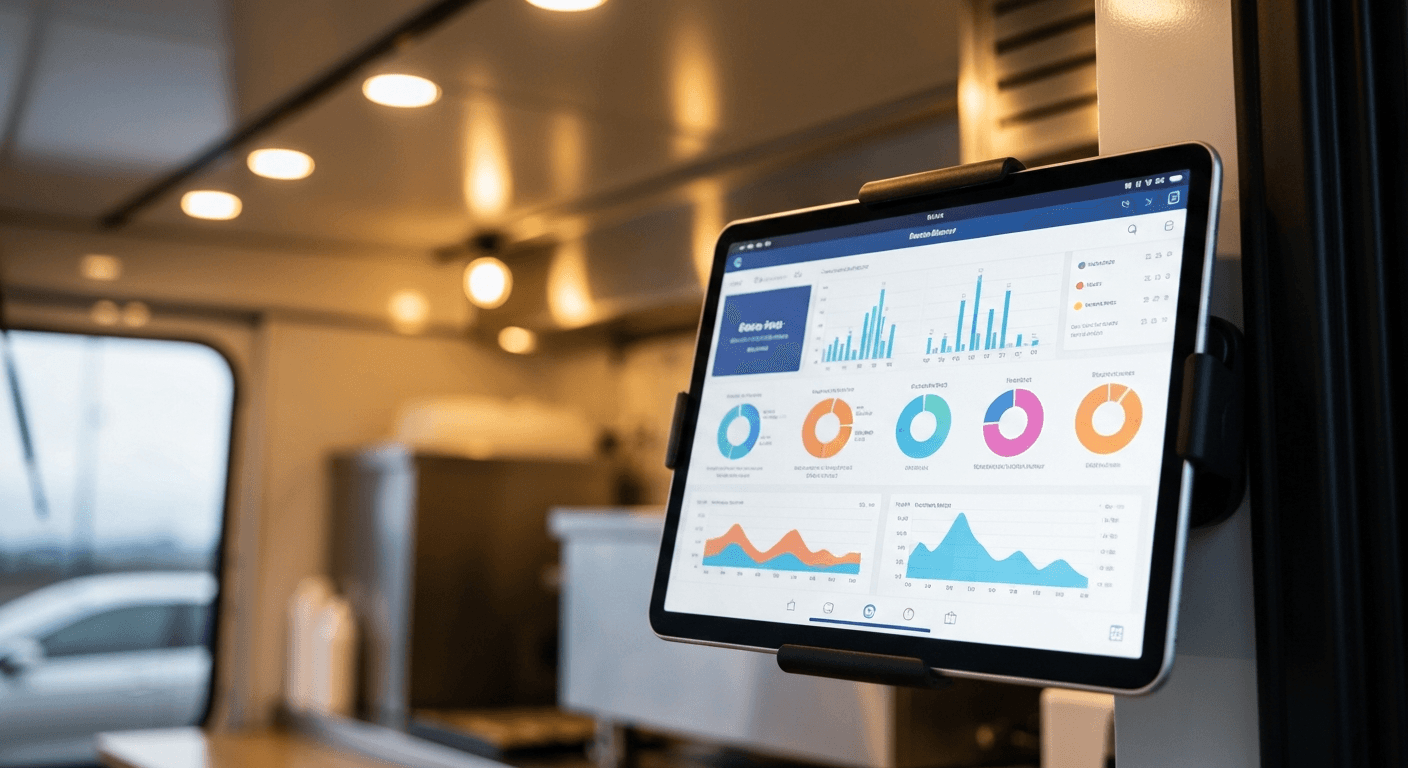
With FoodTracks, compare for each location:
- Average revenue per service: how much you take in at each spot
- Average ticket: the average amount per customer
- Number of tickets: the volume of customers served
- Net margin: revenue minus spot-related costs (fees, fuel, etc.)
Step 4 — Continuous Optimization
- Test a new spot every month to replace your weakest one
- Adapt your schedule to the season: more outdoor spots in summer, more sheltered spots in winter
- Track weather impact: cancel an exposed spot when rain is forecast, replace it with a covered one
- Communicate your schedule on Instagram and Google so customers know where to find you
Classic Mistakes to Avoid
- Choosing a location just because it's free — a free but empty spot costs more (wasted time, unsold stock) than a paid but busy spot
- Not checking regulations before setting up — a fine or eviction ruins your day and your reputation
- Staying at a bad spot out of habit — if a location doesn't perform after 3 tests, drop it without hesitation
- Ignoring travel time — a spot 45 minutes away costs you 1.5 hours of unproductive round-trip time + fuel
- Not analyzing sales data by location — without data, you're flying blind. Use FoodTracks to objectively compare your spots
Conclusion
Choosing your food truck locations is the decision with the biggest impact on your revenue. Don't leave it to chance: adopt a methodical approach by testing, measuring, and optimizing each spot.
With FoodTracks, you can track sales by location, compare each spot's profitability, and make decisions based on real data — not gut feelings.
Analyze your locations with FoodTracks →
Also read: Weather and Food Truck Sales · How to Manage Food Truck Inventory · How to Calculate Your Dish Selling Price
Frequently Asked Questions
- What is the best location for a food truck?
- The best food truck location combines high and recurring foot traffic, low direct competition, easy vehicle access, and valid permits. Office districts at lunchtime, weekly markets, and university campuses are typically the most profitable spots. Ideally, test several locations over 2–3 weeks and analyze your sales with a tool like FoodTracks to objectively identify the top performers.
- Do you need a permit to park a food truck?
- Yes, in almost all cases. To park on a public road, you need a temporary occupancy permit (AOT) from the city hall. On private land, a written agreement with the owner is required. At a market, the municipal market manager assigns pitches. Penalties for unauthorized parking can range from a €135 fine to having your vehicle towed.
- How do you know if a food truck location is profitable?
- To assess a location's profitability, track three metrics: revenue generated at the spot, average ticket per customer, and occupancy cost (fees, travel, commute time). With FoodTracks, you can automatically compare each location's performance and calculate your net margin per spot. A location is profitable when your net margin exceeds 60% of revenue after deducting all spot-related costs.
- How many different locations should a food truck have?
- Most profitable food trucks rotate between 4 to 7 locations throughout the week. This covers different time slots (lunch, evening, weekends) and smooths out foot traffic variations. Too few spots make you dependent on a single location; too many scatter your efforts and reduce customer loyalty. The ideal setup is a stable weekly schedule with 2–3 fixed spots and 1–2 event-based locations.
- Where should you park your food truck in the evening and on weekends?
- In the evening, the best spots are areas near theaters, cinemas, and concert halls, bar and restaurant districts, and dense residential neighborhoods (especially on Friday evenings). On weekends, artisan markets, flea markets, sports events, and busy public parks generate the best revenue. Also consider shopping areas on Saturday afternoons. Adapt your menu to the context: quick street food in the evening, more family-friendly offerings on weekends.