Why Choosing Your Vehicle Is the Most Important Decision
Your vehicle is the heart of your food truck business. It is your kitchen, your shopfront and your daily workhorse all in one. A poor vehicle choice can drag down your profitability for years, while a thoughtful decision gives you a competitive edge from day one.
Many first-time food truckers rush to buy the first truck that "looks right" on a marketplace. The result: repeated breakdowns, a layout that doesn't suit their concept, and unexpected costs that keep climbing. This guide helps you make the right choice, step by step.
The Different Types of Food Truck Vehicles
The converted truck: the classic choice
A converted truck (Citroen HY, Mercedes Sprinter, Renault Master, Fiat Ducato and similar) remains the most popular option. It offers a solid balance of workspace, mobility and brand image.
Pros:
- Full autonomy - you travel with your kitchen
- Large work area (6 to 12 sqm depending on the model)
- Professional image that inspires customer trust
- Built-in storage space
- High purchase price (EUR 25,000 to 120,000 depending on condition and fit-out)
- Significant fuel consumption
- Heavy vehicle licence sometimes required (above 3.5 tonnes)
- Expensive mechanical maintenance
- Second-hand, to be fitted out: EUR 8,000 to 25,000 (vehicle only)
- Second-hand, already fitted out: EUR 20,000 to 60,000
- New, turnkey: EUR 50,000 to 120,000
The food trailer: flexibility first
Food trailers are an increasingly popular alternative, especially for beginners. You tow them with a regular vehicle (van, SUV) and drop them on site.
Pros:
- More affordable price (EUR 10,000 to 50,000 fitted out)
- No special licence needed (if combined weight stays under 3,500 kg)
- Towing vehicle can be used for other purposes
- Less mechanical maintenance (no engine)
- Can be left on a fixed pitch
- Reduced manoeuvrability while towing
- Requires a suitable towing vehicle
- Sometimes less workspace
- Less flexible for tight pitches
- Second-hand fitted trailer: EUR 8,000 to 25,000
- New fitted trailer: EUR 15,000 to 50,000
- Towing vehicle (on top): EUR 5,000 to 20,000
Cargo trikes and cargo bikes: the urban trend
Electric cargo trikes and cargo bikes are perfect for lightweight urban concepts: coffee, crepes, ice cream, fresh juice, hot dogs.
Pros:
- Very low entry price (EUR 3,000 to 15,000)
- No special licence required
- Easy access to pedestrian zones and markets
- Eco-friendly image that customers love
- No fuel costs, minimal maintenance
- Very limited menu (cold preparation or simple reheating)
- Minimal storage
- Weather-sensitive
- Not suited for high volumes
- Second-hand cargo trike: EUR 2,000 to 6,000
- New fitted cargo trike: EUR 5,000 to 15,000
New vs Second-Hand: How to Decide
Second-hand: the pragmatic choice
For a first food truck, buying second-hand is often the wisest move. You cap your initial investment and can test your concept without risking a huge amount of capital.
Key checks on a second-hand vehicle:
- Have the engine and gearbox diagnosed by a mechanic
- Inspect the body (corrosion, waterproofing, floor condition)
- Verify gas and electrical installations are compliant
- Ask for maintenance and fit-out invoices
- Test all kitchen equipment (fridges, hob, fryer)
- Check the latest roadworthiness test date
Buying new: peace of mind
A new vehicle custom-fitted by a professional guarantees compliance, reliability and a layout perfectly matched to your concept.
When to buy new:
- You have a solid budget (or approved financing)
- Your concept is well-defined and tested (e.g. after a season using a second-hand truck)
- You are planning long-term (5 years minimum)
- You want a fully optimised custom layout
Interior Fit-Out: The Key to Efficiency
Designing an efficient kitchen layout
The fit-out matters as much as the vehicle itself. A smart layout can save you 2 to 5 seconds per order, which translates into dozens of extra orders per service.
Golden rules for your layout:
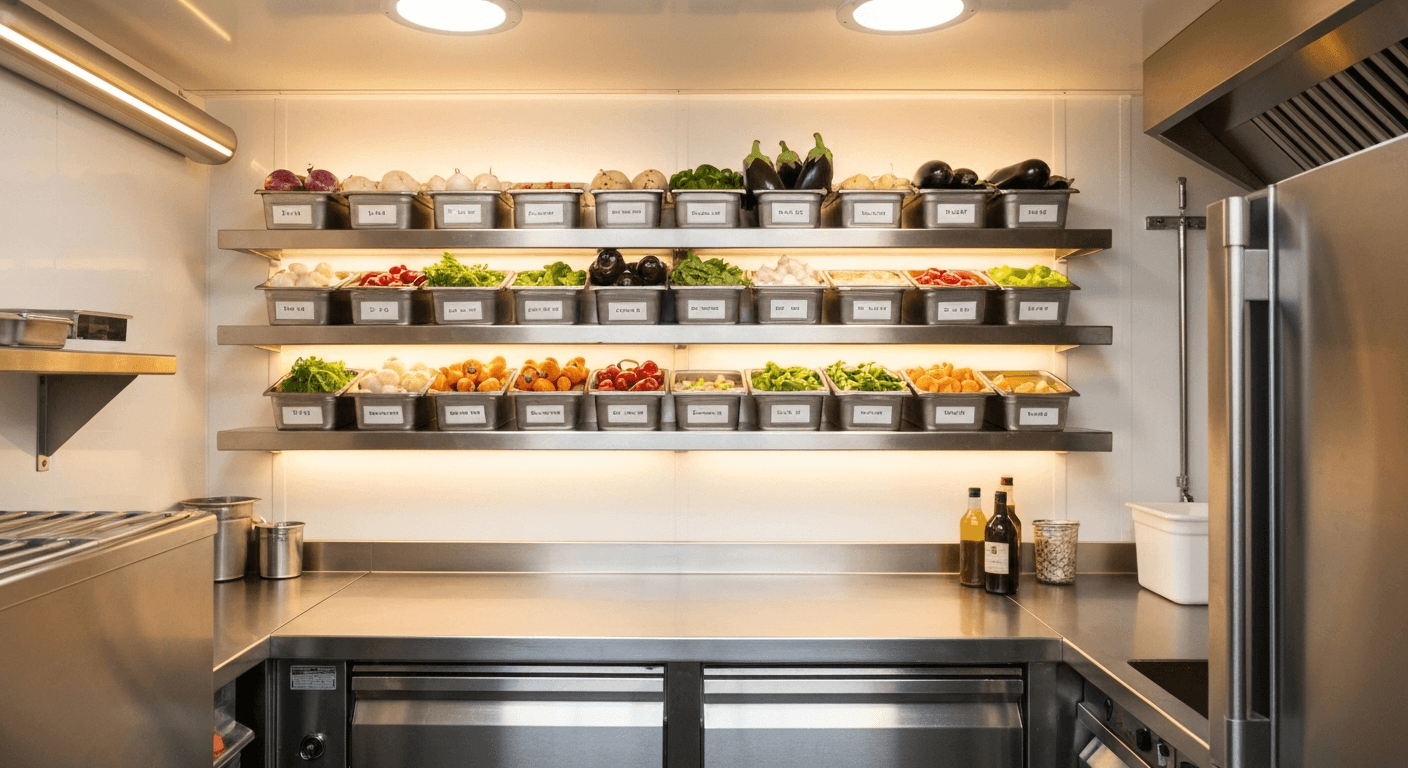
- Forward flow - food always moves from storage to preparation, then cooking, then service, with no backtracking
- The work triangle - storage, prep and cooking zones should form a compact triangle
- Ergonomics - everything should be reachable without bending or twisting. The rush lasts 2 to 3 hours, and your back will thank you
- Ventilation - a high-performance extraction system is mandatory and vital for your comfort
Essential equipment
Here is a baseline list for a standard food truck:
- Stainless-steel worktops (required for food-safety standards)
- Grease trap and waste-water disposal system
- Professional refrigerator (or refrigerated display)
- Hob or griddle (gas or electric)
- Deep fryer (if your concept requires it)
- POS system or payment terminal (SumUp is very popular among food truckers)
- Fire extinguisher and fire blanket
Fit-out budget
Fit-out costs vary widely depending on the level of finish:
- Basic (assisted DIY): EUR 5,000 to 15,000
- Professional standard: EUR 15,000 to 35,000
- High-end custom: EUR 35,000 to 70,000
Regulations and Approval: What You Need to Know
Vehicle registration and weight limits
If your vehicle exceeds 3,500 kg gross vehicle weight, you will need a heavy-vehicle licence. Most modern food trucks stay under this limit to avoid the requirement.
Watch out: the weight of the fit-out and equipment is added to the unladen vehicle weight. A Sprinter weighing 2,500 kg empty can easily reach 3,400 kg once fitted out and loaded. Get it weighed before purchasing.
Food-safety standards (HACCP)
Your vehicle must meet the same hygiene standards as a fixed restaurant:
- Washable, non-absorbent surfaces (stainless steel required)
- Potable hot-and-cold water supply
- Separate hand-washing basin
- Temperature control system (cold chain)
- Grease trap for waste water
Gas installations
If you use gas (butane or propane), the installation must be completed or inspected by a certified professional. You must have:
- A gas-compliance certificate
- A working gas detector
- Upper and lower ventilation openings
- An accessible emergency shut-off valve
Insurance
Your food truck needs specialist insurance covering:
- Professional liability
- The vehicle (stated as "converted")
- Contents (equipment and stock)
- Loss of earnings (recommended)
How to Set Your Total Budget
Here is a summary of budget ranges for getting started:
Economy formula (cargo trike or second-hand trailer):
- Vehicle: EUR 3,000 to 15,000
- Fit-out: EUR 2,000 to 8,000
- Kitchen equipment: EUR 2,000 to 5,000
- Total: EUR 7,000 to 28,000
- Fitted vehicle: EUR 20,000 to 45,000
- Refurbishment and customisation: EUR 3,000 to 10,000
- Additional equipment: EUR 2,000 to 5,000
- Total: EUR 25,000 to 60,000
- New vehicle: EUR 25,000 to 50,000
- Professional fit-out: EUR 25,000 to 70,000
- High-end equipment: EUR 5,000 to 15,000
- Total: EUR 55,000 to 135,000
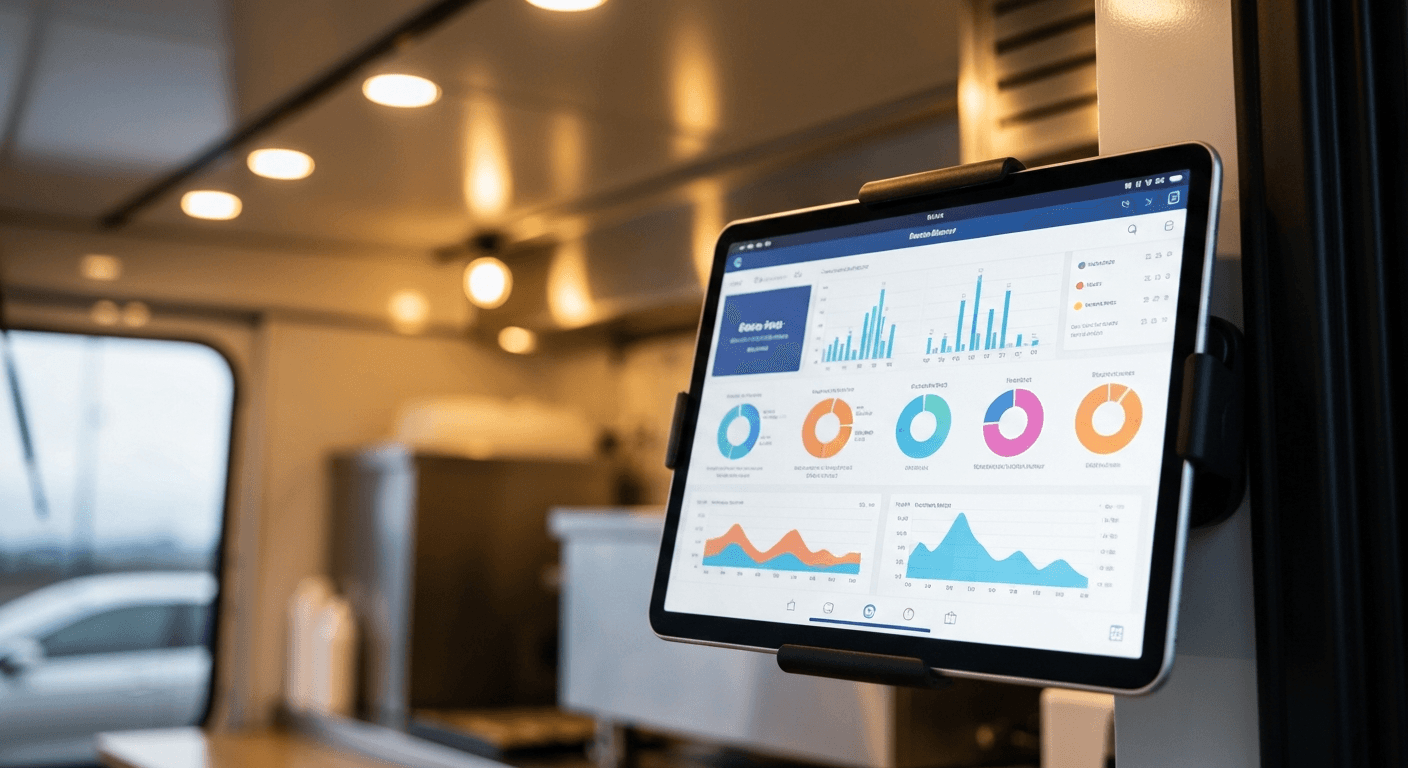
Use the FoodTracks financial tracking tool to plan these expenses and monitor your return on investment month by month. The dashboard shows you at a glance whether your business is covering all costs, including vehicle repayments.
7 Practical Tips Before You Buy
- Define your concept before looking for a vehicle. The vehicle must fit your menu, not the other way around.
- Visit at least 3 operating food trucks. Talk to the owners and ask what they would change if they could start over.
- Have the vehicle inspected by an independent mechanic before any second-hand purchase.
- Calculate the total cost of ownership over 3 years (purchase + fit-out + maintenance + fuel + insurance), not just the sticker price.
- Check the dimensions against the pitches you are targeting. Some markets limit vehicle size.
- Think about resale value. A well-fitted and well-maintained vehicle resells easily. Unusual vehicles (buses, vintage vans) are harder to resell.
- Don't spend everything on the vehicle. Keep budget for initial stock, marketing and a cash reserve.
Conclusion: An Investment Worth Planning Carefully
Choosing your food truck vehicle is a major investment that will shape your daily life and profitability for years. Take the time to define your needs clearly, compare options and calculate your total budget before committing.
Start with your concept, estimate your projected revenue, then determine which vehicle matches your means and ambitions. A tool like FoodTracks can help you structure your business plan, track expenses and verify that your projections hold up month after month.
Whatever you choose, the key is to start with a reliable, compliant vehicle that suits your offering. You can always upgrade to a larger or better-equipped vehicle once your business is profitable.
Frequently Asked Questions
- What budget should I plan for a first food truck?
- For a first food truck, budget between EUR 7,000 and 60,000 depending on the vehicle type. A second-hand trailer or cargo trike starts at EUR 7,000, while a second-hand fitted truck costs EUR 25,000 to 60,000. Add 3-6 months of fixed costs as a cash reserve.
- Do you need a special licence to drive a food truck?
- If your food truck stays under 3,500 kg gross vehicle weight, a standard car licence is enough. Above that, you need a heavy-vehicle licence. Remember that the weight of the fit-out and equipment is added to the unladen vehicle weight.
- Is it better to buy a new or second-hand food truck?
- For a first food truck, second-hand is often preferable to limit financial risk. Set aside 20-30% of the purchase price for refurbishment. Buying new is recommended when your concept is proven, you are planning long-term, and you have a solid budget or financing in place.
- What regulations must a food truck vehicle meet?
- A food truck must comply with HACCP standards (stainless-steel surfaces, hot and cold potable water, hand-washing basin, cold chain), gas installation compliance (certificate required), and weight regulations. The food-safety authority can inspect your vehicle at any time.